
Last updated July 11, 2026
Air Duct Cleaning Maintenance Checklist for Philadelphia Homeowners
That gray streaking around your return air grille? It’s not dust settling — it’s a pressure signature. In our 14 years working Philadelphia homes from Fishtown to Chestnut Hill, we’ve learned that homeowners who can read these visual cues catch duct problems before they turn into $2,000 repairs. Most maintenance checklists are written for technicians with access tools and cameras. This one is different. It’s built for what you can observe from the living room, the basement, and the attic hatch — the specific indicators that tell you whether your system needs attention, a filter change, or a call to a specialist before the next season hits.
Quick Answer
Philadelphia homeowners should inspect supply and return registers quarterly for visible debris, filter bypass streaking, and airflow changes; replace filters every 60–90 days during shoulder seasons when heating and cooling cycles overlap; and schedule professional duct cleaning every 3–5 years, or sooner after renovation, rodent activity, or visible mold. Document everything — filter dates, HVAC service visits, and register airflow baselines — so you have measurable history instead of guesswork when problems develop.
Table of Contents
- The Room-by-Room Visual Inspection Homeowners Can Do
- Filter Maintenance for Philadelphia’s Unpredictable Shoulder Seasons
- How to Document Baseline Airflow Before Problems Start
- Structural Red Flags: When It’s Not Just a Cleaning Problem
- Building a Service History Log Contractors Can Actually Use
- Your Seasonal Maintenance Calendar
- Common Mistakes to Avoid
- When to Call a Professional
- Frequently Asked Questions
The Room-by-Room Visual Inspection Homeowners Can Do
You don’t need a borescope camera to spot trouble. What you need is a consistent walk-through sequence and the knowledge of what “normal” actually looks like. We teach this to every Philadelphia homeowner who asks — and in neighborhoods like Mount Airy and Queen Village, where rowhouse duct systems run through finished walls with no access panels, visual observation at the registers is often your only early warning system.
Start with Supply Registers (the ones pushing air into rooms)
- Look for dark radial streaking on the ceiling or wall around the register. This indicates air is escaping between the register boot and the drywall — a gap that pulls attic or wall cavity dust into your conditioned air. In Philadelphia’s older housing stock, especially pre-war brick homes in Germantown, these gaps are nearly universal as plaster settles and sealants age.
- Check the register vanes for uniform dust accumulation. A little dust is normal. Clumped, greasy buildup suggests the filter has been bypassing for months, or the return path is pulling from a kitchen or bathroom without proper isolation.
- Feel for consistent temperature across all vanes. If one side blows cold and the other lukewarm during cooling season, you may have a disconnected duct branch inside the wall — common in Philadelphia homes where flexible duct was retrofitted through existing chases in the 1980s and 90s.
Move to Return Air Grilles (the larger ones pulling air back)
- Inspect the filter frame for gaps or bypass trails. The gray streaking we mentioned in the opening? It forms when air finds a path around the filter rather than through it. This is the single most common preventable problem we see in Philadelphia homes.
- Remove the filter and check the blower side for debris bypass. If you see a clean filter but dirty housing behind it, the filter is either poorly fitted, the wrong size, or the housing itself is deformed from years of pressure cycling.
- Listen for whistling or rumbling at high fan speed. Whistling usually means a restriction (dirty filter, closed damper). Rumbling suggests a loose duct connection vibrating against framing — something that worsens dramatically in Philadelphia’s freeze-thaw cycles as wood expands and contracts.
The Basement and Utility Room Check
In Philadelphia’s typical basement configurations — low ceilings, utility clusters near the front or rear foundation wall — this is where you’ll spot the problems that affect every room above.
- Exposed flex duct: Look for sagging between supports (should be supported every 4–5 feet), crushed sections where someone leaned storage against it, and disconnected collars where the clamp has loosened. Philadelphia’s humidity swings make flex duct insulation heavy; unsupported runs sag and kink within a few years.
- Plenum connections: The sheet metal box on top of your furnace or air handler should show no gaps at seams. A flashlight held inside while the system runs will reveal light leaks — which are also air leaks.
- Condensate and rust patterns: Rust streaks below the air handler often indicate that humid return air is leaking before reaching the cooling coil, causing condensation on the cabinet exterior. This is especially common in Philadelphia’s late spring when outdoor dew points spike before homeowners switch to cooling.
Filter Maintenance for Philadelphia’s Unpredictable Shoulder Seasons
Philadelphia’s shoulder seasons — April through mid-May, and September through October — create a unique filter stress pattern that most national guidance misses. Temperatures swing 30 degrees in 48 hours. Your system switches from heating to cooling and back, sometimes within the same week. Each switch changes airflow direction, pressure differentials, and the type of particulate loading your filter sees.
Here’s what we’ve learned from 14 years of filter inspections across the city:
The 60-Day Rule for Shoulder Season Months
During April–May and September–October, check your filter every 60 days regardless of what the packaging claims. The MERV rating and “90-day” label assume consistent operation in a single mode. Philadelphia’s cycling reality means:
- Heating mode pulls more combustion byproducts and fine soot through the return — especially if you have an older gas furnace in a rowhouse with shared chimney flues, common in Kensington and Port Richmond.
- Cooling mode increases humidity loading, which causes filter media to swell and restrict airflow faster than dry operation.
- Each mode switch dislodges settled dust that then loads the filter unevenly.
Filter Sizing: The Quarter-Inch Problem
Philadelphia’s housing stock includes decades of non-standard filter slots. We regularly find 15.5″ × 19.5″ openings with a 16 × 20 filter crammed in, or a 20 × 25 stuffed into a 19.75 × 24.75 slot with the cardboard bent. Both create bypass. Measure your actual slot opening with a tape measure, then buy the exact size — or have a custom filter rack installed if your system is truly odd-sized. Bluepeak Air Duct & Vent Cleaning Pennsylvania home assessments include filter housing measurements because this detail matters more than filter brand.
MERV Rating Guidance for Local Conditions
Philadelphia’s urban particulate mix — road dust, pollen from Fairmount Park’s tree canopy, industrial residual in river wards — justifies MERV 11–13 for most homes. But check your system’s fan capacity first: older furnaces in Philadelphia’s pre-war housing often can’t overcome the static pressure of MERV 13 without airflow degradation. When in doubt, MERV 8 with perfect fit beats MERV 13 with bypass.
How to Document Baseline Airflow Before Problems Start
“The bedroom doesn’t get enough air” is the most common complaint we hear — and the least useful for diagnosis. What was “enough” six months ago? Without a baseline, you’re guessing. Here’s how to create measurable documentation that any technician can use, including us when you call Air Duct Cleaning in Carnegie or our Philadelphia service area.
The Simple Register Velocity Method
You don’t need a $400 anemometer. A $15 wind speed meter from any hardware store, or even a simple ribbon test, creates comparative data that reveals trends.
- Choose a consistent test condition: System in cooling mode, fan on high, all interior doors open, on a day between 70–80°F outdoors. Record the date and outdoor temperature.
- Measure at each supply register: Hold the meter centered in the register face, perpendicular to airflow. Record feet-per-minute (FPM) or use a 12-inch ribbon strip and note “horizontal,” “45-degree,” or “droop” as a simple scale.
- Map your home: Sketch each floor with register locations and your measurements. Note which registers serve which rooms — in Philadelphia rowhouses, this isn’t always obvious due to decades of modifications.
- Repeat seasonally: Same conditions, same method. A 20% drop at any single register indicates a developing blockage or disconnection. A uniform 20% drop across all registers suggests filter loading or blower degradation.
What to Record in Your Log
- Date, outdoor temperature, system mode (heat/cool/fan-only)
- Filter age (days since replacement)
- Any recent home changes: renovation, new furniture, window replacement, pest treatment
- Subjective notes: odors, noise changes, humidity complaints, allergy symptoms
This log transforms “something’s wrong” into “the northeast bedroom register dropped from 380 FPM to 220 FPM between March and June, after we had the bathroom tiled.” That specificity saves diagnostic time and money.
Structural Red Flags: When It’s Not Just a Cleaning Problem
Some symptoms indicate that duct cleaning alone will waste your money — the system needs repair or sealing first. We’ve arrived at Philadelphia homes where a homeowner paid for “duct cleaning” six months earlier, only to find the real problem was a disconnected branch that was never addressed.
Signs of Disconnected or Collapsed Ductwork
- A room that never reaches temperature despite strong airflow elsewhere: Often a fully disconnected flex duct dumping conditioned air into a wall cavity or attic. In Philadelphia’s finished attics in Manayunk and Roxborough, we find these hidden behind knee-wall drywall.
- Visible flex duct with a “pinched” or flattened section: Flex duct has a rated bend radius. Tighter bends collapse the internal helix and create permanent restriction. If you can see this in your basement, there’s likely more hidden above.
- Supply register that blows room-temperature air in cooling mode: Suggests the duct is drawing return air from an unconditioned space rather than delivering conditioned air from the handler.
Signs of Duct Leakage at Seams
Sheet metal duct in Philadelphia’s older homes was originally sealed with fabric tape and paste — materials that degrade after 20–30 years. Look for:
- Dust streaks radiating from seam locations, especially on horizontal runs where settling occurs
- Rust patterns that don’t correspond to condensate lines — indicating humid unconditioned air is being drawn through gaps
- Insulation that has shifted or sagged away from seams, revealing gaps
When Sanitizing Won’t Help
Musty odors that return within days of cleaning usually indicate an ongoing moisture source, not residual contamination. In Philadelphia’s basement-heavy housing, we see this where:
- Foundation seepage keeps duct in contact with damp air
- A condensate drain is blocked or improperly trapped, allowing standing water
- Return duct passes through a crawlspace with inadequate vapor barrier
These conditions require repair and moisture control before any cleaning or sanitizing has lasting effect. Our HVAC Cleaning in Carnegie and Philadelphia assessments always include moisture source identification for this reason.
Building a Service History Log Contractors Can Actually Use
The most expensive service call is the one where the technician spends 45 minutes reconstructing your system’s history from memory and guesswork. A simple log eliminates this — and in Philadelphia’s competitive service market, it signals that you’re an informed customer who values precision over platitudes.
What to Include
| Category | Details to Record | Why It Matters |
|---|---|---|
| HVAC Service | Date, company name, technician name, work performed, refrigerant added (if any) | Refrigerant history reveals leak patterns; repeat companies may have institutional knowledge of your system |
| Filter Changes | Date, brand/model, MERV rating, measured pressure drop (if known) | Establishes maintenance interval that actually works for your conditions |
| Duct Cleaning | Date, company, scope (supply only, full system, dryer vent included), equipment used | Rotobrush or Nikro HEPA systems versus shop-vac methods produce different results and different re-cleaning intervals |
| Home Events | Renovation dates, pest treatments, water damage incidents, window/door replacements | Each introduces contaminants or changes pressure balance |
| Airflow Baselines | Seasonal measurements as described above | Objective trend data for performance degradation |
Physical vs. Digital
We recommend a physical notebook stored near the HVAC system, supplemented with phone photos of filter labels, service invoices, and any visible duct conditions. The notebook survives dead batteries and cloud account issues — and it’s right there when any technician opens the utility closet. In Philadelphia’s rental market, this log also protects security deposit disputes by documenting pre-existing conditions.
Your Seasonal Maintenance Calendar
Spring (March–May)
- Replace filter before first cooling cycle — Philadelphia’s tree pollen peaks in April, and a loaded filter from heating season will fail fast
- Run the visual inspection sequence, paying special attention to condensate drain and pan condition
- Document baseline airflow in cooling mode
- Schedule professional duct cleaning if it’s been 3+ years, or if you ran heating with a visible bypass condition all winter
Summer (June–August)
- Check filter monthly — high humidity increases biological loading
- Monitor for musty odors at startup, which indicate condensate or drain issues
- Verify that basement duct is dry after heavy rains — Philadelphia’s summer storms can overwhelm older drainage
Fall (September–November)
- Replace filter before first heating cycle
- Inspect heat exchanger area for soot or rust streaks — not a homeowner repair, but a critical observation to report
- Document baseline airflow in heating mode
- Check for rodent entry at exterior penetrations — Philadelphia’s fall temperature drop drives pests toward structure warmth
Winter (December–February)
- Check filter every 60 days — heating mode runs longer cycles with less filter rest
- Monitor for dry air symptoms that indicate excessive infiltration or duct leakage
- After any significant snow or ice event, check attic duct access for moisture intrusion
Common Mistakes to Avoid
- Using the “cheapest filter that fits” approach. A poorly fitting MERV 4 fiberglass panel costs more long-term than a properly sized MERV 8 pleated filter, because the bypass it creates loads your blower, coil, and ductwork with unfiltered air. In Philadelphia’s older housing with already-compromised duct sealing, this accelerates degradation.
- Cleaning registers with aerosol disinfectants. The propellant and fragrance oils leave a sticky residue that attracts dust and can degrade register vanes. Warm water and mild detergent, fully dried, is the correct method.
- Blocking supply or return registers with furniture “temporarily.” Every blocked register increases system static pressure, strains the blower, and can cause safety limit trips. In Philadelphia’s compact rowhouse rooms, this is a constant temptation — use deflectors instead of obstructions.
- Assuming “no visible dust” means clean ducts. The contamination that affects health and efficiency is often in the return path and blower housing — areas you can’t see without access. Visual cleanliness at supply registers is not diagnostic.
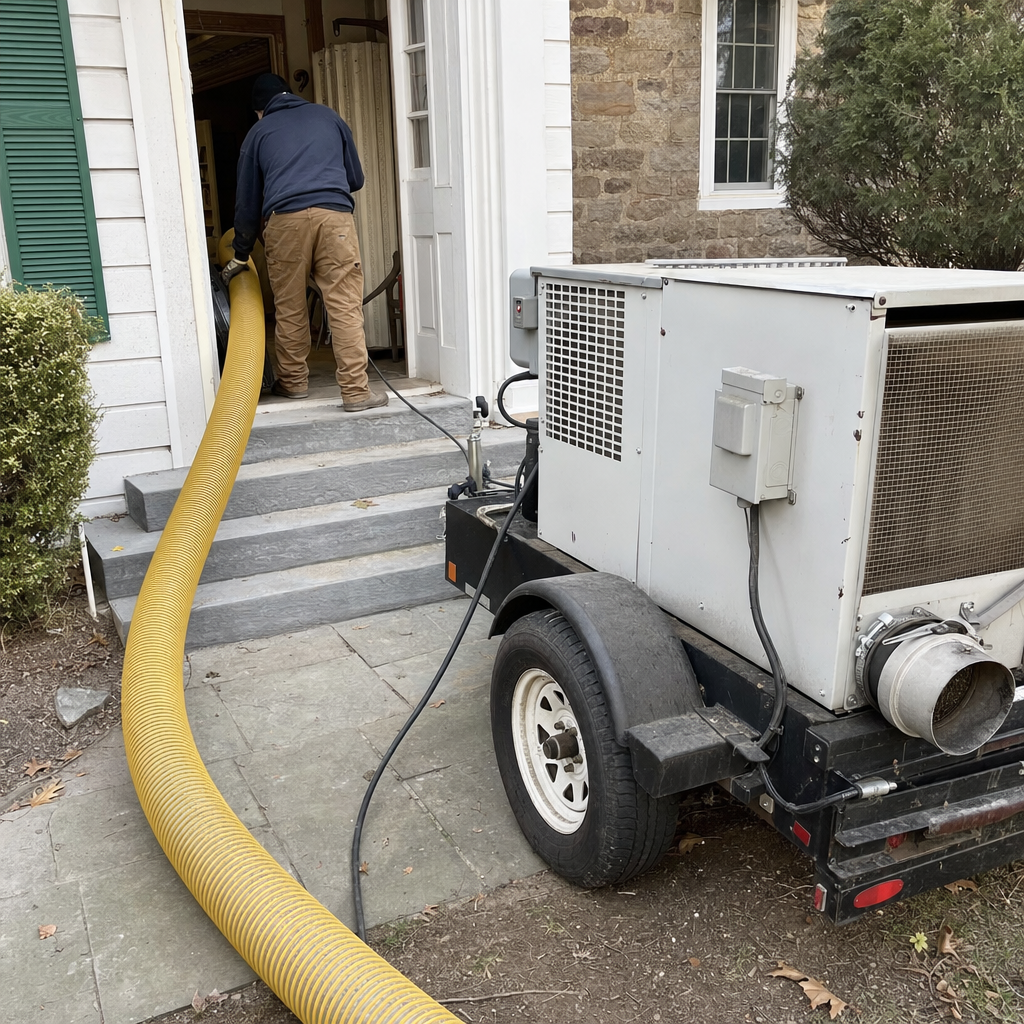
- Hiring based on coupon price without verifying equipment. A shop vac with a 50-foot hose cannot produce the negative pressure and agitation that duct cleaning requires. We use Rotobrush brush-agitation systems and Nikro HEPA-rated vacuums because they’re built for this specific job — not adapted from other trades.
- Ignoring dryer vent maintenance as part of duct system health. A clogged dryer vent increases humidity loading in utility rooms, affects combustion air for gas appliances, and is a leading fire cause. Dryer Vent Cleaning in Carnegie and our Philadelphia service addresses this as a system component, not an afterthought.
When to Call a Professional
Some conditions exceed homeowner capability and require specialized equipment — or involve genuine safety concerns. Call a professional when you observe: visible mold growth on duct surfaces (don’t disturb it — spore release is immediate); rodent or insect infestation evidence in ductwork; a disconnected or collapsed duct section you can see but can’t safely access; persistent musty odor after filter replacement and basic cleaning; or any rust or corrosion on gas furnace heat exchanger or flue components.
Jeffrey Morgan — owner and lead technician — handles your job personally, not through rotating subcontractors. Over 1,100 verified customers have reviewed this work, and 14 years focused on one trade means the diagnostic patterns we’ve developed in Philadelphia’s specific housing stock translate directly to faster, more accurate problem identification. Bluepeak Air Duct & Vent Cleaning Pennsylvania home offers free estimates in Philadelphia — call (844) 951-3591.
Frequently Asked Questions
Every 3–5 years for typical residential occupancy, or sooner after renovation, rodent activity, visible mold, or if anyone in the home has respiratory conditions that warrant stricter control. Philadelphia’s older housing stock and urban particulate loading tend toward the shorter end of that interval. Call (844) 951-3591 for an assessment of your specific conditions — estimates are free.
You can and should maintain registers, replace filters, and monitor for the red flags described in this checklist. But the interior duct surfaces, return plenum, and blower housing require negative-pressure containment equipment and rotary agitation tools to clean without contaminating your home. A shop vac or compressed air without containment simply relocates debris. For the system itself, a professional with Rotobrush or equivalent equipment is necessary.
Shared walls, older construction with less effective air barriers, proximity to traffic and industrial sources, and chimney draft interactions all increase particulate loading. Additionally, many Philadelphia rowhouses have return paths that draw from interior wall cavities rather than dedicated duct, pulling decades of accumulated construction dust. Sealing and proper filter maintenance help, but the structural realities mean more frequent attention is often necessary.
Typical residential duct cleaning for a Philadelphia rowhouse or twin ranges from $400–$800 depending on system size, accessibility, and contamination level. Larger detached homes or systems with substantial repair needs may run higher. We provide exact quotes after inspection, not range guesses that change on arrival. Call (844) 951-3591 for a free estimate.
It can, if the allergen loading is genuinely in the duct system — pollen accumulation, dust mite debris, pet dander buildup. But duct cleaning is not a standalone allergy solution. It should be paired with source control (bedding, flooring, humidity management), proper filtration (Aprilaire media cleaners for whole-house coverage), and in some cases duct sealing to prevent recontamination. We assess whether duct cleaning is the right intervention or if your money is better directed elsewhere.
Cleaning removes physical debris through mechanical agitation and vacuum extraction. Sanitizing applies an EPA-registered antimicrobial to reduce biological loading on clean surfaces — it’s a finishing step, not a substitute for cleaning. We use Guardsman products where biological concern exists, but only after thorough cleaning and with full disclosure of what’s being applied. Sanitizing unclean ducts is ineffective and potentially misleading.
The Bottom Line
Effective duct maintenance isn’t about perfection — it’s about consistent observation and timely intervention. The Philadelphia homeowner who checks registers quarterly, replaces filters on a shoulder-season schedule, documents airflow baselines, and knows the difference between a cleaning need and a structural repair saves money and breathes easier. The checklist above gives you the specific observational tools that most guides reserve for technicians. Use them, log what you find, and when the indicators point beyond DIY scope, call a specialist who can work from your documentation rather than starting from zero.
Written by Jeffrey Morgan, Owner & Lead Technician at Bluepeak Air Duct & Vent Cleaning Pennsylvania, serving Philadelphia since 2012.