
Last updated July 11, 2026
How to Hire a Air Duct Cleaning Contractor in Philadelphia: A Step-by-Step Guide
Here’s a number that stops most homeowners cold: NADCA, the National Air Duct Cleaners Association, estimates that a typical six-room home collects up to 40 pounds of dust, dander, and debris in its ductwork every year. In Philadelphia, where rowhouse construction from the 1920s to 1950s leaves many homes with original galvanized ductwork and limited access points, that accumulation behaves differently than in newer construction. Yet the Philadelphia market is flooded with carpet cleaning companies, general handymen, and HVAC outfits who add “duct cleaning” to their menu without the focused equipment or methodology this job demands. This guide will teach you to cut through the noise and identify a contractor who understands your specific duct system — not just someone with a vacuum and a business card.
Quick Answer
To hire a legitimate air duct cleaning contractor in Philadelphia, verify they use negative-pressure source removal with truck-mounted or trailer-mounted HEPA vacuum systems, request a written scope defining work by register count or linear footage, and insist on before-and-after video documentation. Avoid any company offering whole-house cleaning for under $300, arriving with portable shop vacuums, or unable to explain why brush-agitation method matters for your specific duct material.
Table of Contents
- Why NADCA Certification Alone Isn’t Enough
- The Equipment Questions That Expose Real Expertise
- How to Read Reviews Like a Technician
- Why Three Quotes Beat One Price — But Only If You Get Scope in Writing First
- Contract Terms That Protect Philadelphia Homeowners
- Red Flags Specific to the Philadelphia Market
- Common Mistakes to Avoid
- When to Call a Professional
- Frequently Asked Questions
Why NADCA Certification Alone Isn’t Enough
Asking “are you NADCA certified?” is the right instinct but the wrong opening question. NADCA sets valuable standards for assessment, cleaning, and restoration of HVAC systems, and certification does require passing a written exam and maintaining continuing education. But certification is administered at the company level or to individual technicians — it doesn’t guarantee the person who shows up at your Philadelphia rowhouse understands the difference between flexible ductwork in a Fishtown rehab and the rigid galvanized steel running through a Mount Airy twin.
In our 14 years focused exclusively on air ducts and vents, we’ve been called behind NADCA-certified companies who left significant debris because they used contact vacuum methods on heavily soiled rigid mains, or who damaged flexible ductwork by running brush systems without adjusting RPM for the material. The certification proves they passed a test. It doesn’t prove they’ve developed judgment through repetition in the specific conditions your home presents.
The better opening question: “What percentage of your annual revenue comes from duct cleaning specifically?” A company that derives 80% or more of its income from this single trade has different incentives than a carpet cleaner who added ducts last year or an HVAC contractor who sees cleaning as a shoulder-season filler. At Bluepeak Air Duct & Vent Cleaning Pennsylvania home, duct work isn’t an add-on — it’s the entire business. That concentration shapes everything from equipment investment to technician training to how we structure callbacks.
Follow up with: “Will the same person who assesses my system perform the work?” In many franchise and multi-crew operations, a sales representative visits for the quote, then a different team — sometimes subcontractors — arrives days later. You lose the continuity of someone who observed your specific duct configuration, noted the access limitations, and planned the approach accordingly. Jeffrey Morgan — owner and lead technician — handles your job personally, from the initial assessment through the final register reinstallation. That direct accountability changes how thoroughly questions get asked and how carefully problems get flagged.
The Equipment Questions That Expose Real Expertise
Equipment specificity separates technicians from marketers. Any competent contractor should be able to explain, without prompting, which of these two primary methodologies they use and why:
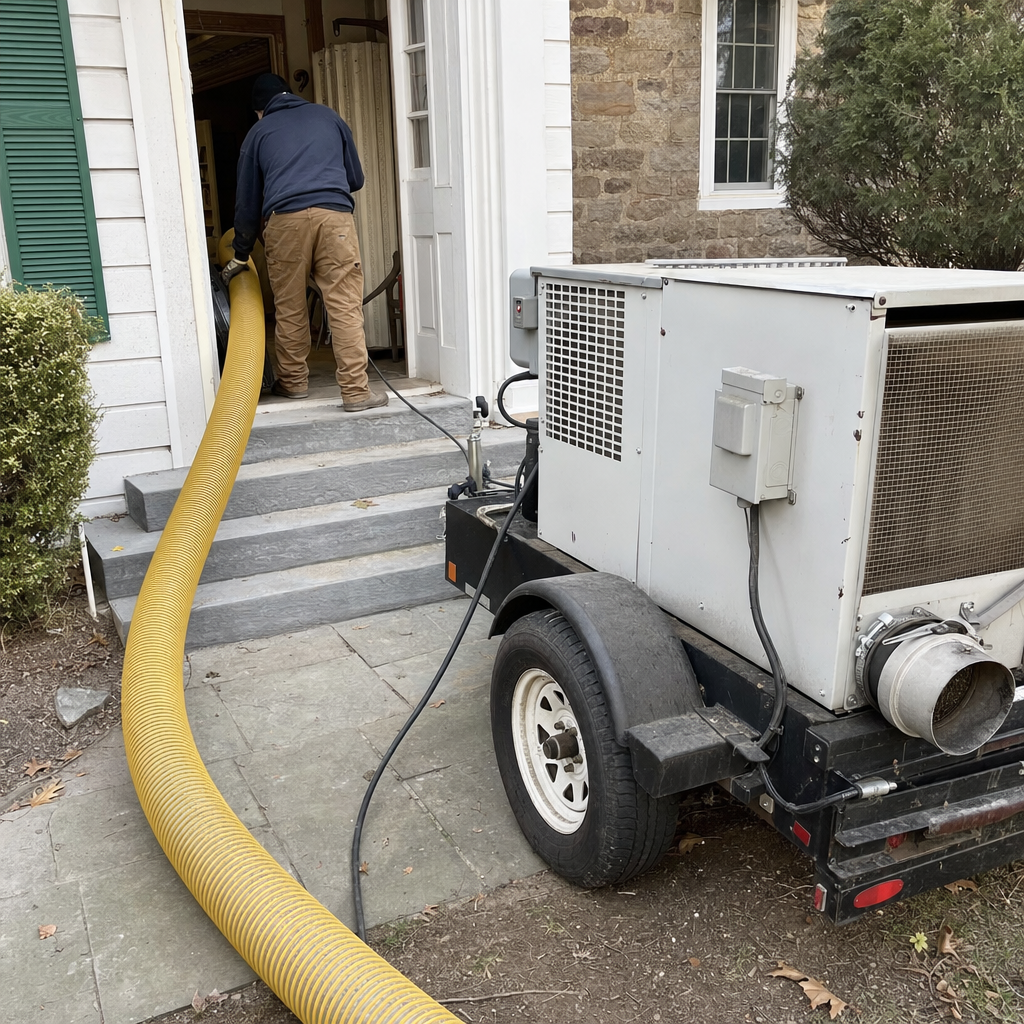
Negative-pressure source removal creates suction throughout the duct system using a powerful vacuum (typically 5,000+ CFM, truck-mounted or trailer-mounted) connected at the air handler or a large trunk line. This negative pressure contains dislodged debris and prevents it from entering occupied spaces. It’s the industry standard for thorough cleaning, particularly in Philadelphia’s older homes where decades of accumulation require aggressive debris extraction.
Contact vacuum systems use portable HEPA vacuums with brush attachments, inserting the tool directly into each branch line. These work for light maintenance or limited-access situations but lack the containment capacity for heavily soiled systems. They’re also what you’ll typically see from carpet cleaning companies who bought a $400 portable unit and added “duct cleaning” to their service menu.
Ask these specific equipment questions before booking:
- “Is your vacuum truck-mounted, trailer-mounted, or portable?” Truck-mounted and trailer-mounted systems from Nikro and Abatement Technologies deliver the sustained CFM and HEPA filtration necessary for source removal. Portable units have their place — we carry them for high-rise condos in Center City where truck access is impossible — but they’re a compromise, not a primary solution.
- “What brush-agitation system do you use, and can you adjust it for flexible ductwork?” Rotobrush systems use rotating brushes with variable-speed motors that we adjust based on duct material. Rigid metal tolerates aggressive agitation; flexible ductwork requires lower RPM to prevent tearing the inner liner. A technician who doesn’t understand this distinction can damage your system while “cleaning” it.
- “How do you contain debris during the cleaning?” Proper containment means HEPA-filtered negative air machines, sealed access points, and protective coverings on floors and furnishings. In Philadelphia’s tight rowhouse layouts, where the basement air handler sits directly below living spaces, poor containment means your living room becomes part of the cleaning zone.
- “What do you use for sanitizing, if that’s part of the scope?” EPA-registered sanitizers applied through fogging or misting systems are appropriate when microbial growth is documented. But sanitizing without mechanical cleaning first is ineffective — you’re applying chemicals to debris that shields the underlying surface. We use this step only after source removal, with products appropriate for occupied environments.
The contractor who hesitates on these questions, or who describes equipment in vague terms like “professional-grade tools” without naming manufacturers, hasn’t invested in the specialization this work requires.
How to Read Reviews Like a Technician
With 1,144 customer reviews averaging 4.8 stars, we’ve learned what review language actually signals about technical quality. Most Philadelphia homeowners scan for star ratings and complaint patterns, but the specific vocabulary reviewers use reveals whether a genuine duct cleaning occurred or a superficial pass-through.
Language that signals real technical work:
- References to “before and after photos” or “video” — documentation requires access, time, and confidence in results
- Mention of “registers removed” or “returns cleaned” — indicates work beyond inserting a vacuum hose at one point
- Specific time durations (“took four hours for our three-bedroom”) — thorough cleaning takes time; a whole-house job done in 90 minutes was not thorough
- Notes about “dust containment” or “protective coverings” — awareness of jobsite management signals professional process
- Comments about “found and sealed a leak” or “repaired a disconnected branch” — indicates scope beyond vacuuming, requiring technical knowledge
Language that signals superficial work:
- “Quick and efficient” without specifics — often means fast, not thorough
- “Great price” as the primary praise point — value matters, but when price dominates the review, technical depth likely didn’t
- No mention of access points opened, registers removed, or duration — suggests limited physical intervention
- “They vacuumed the vents” — “vents” suggests visible register cleaning only, not full system cleaning
Also examine how the company responds to negative reviews. Defensive responses or generic “sorry you feel that way” templates suggest operational distance from customer concerns. Detailed responses that reference specific job conditions indicate owner involvement and institutional memory — the same person handling complaints likely oversaw the work.
Why Three Quotes Beat One Price — But Only If You Get Scope in Writing First
The conventional wisdom of “get three quotes” fails for duct cleaning because prices are meaningless without defined scope. We’ve seen Philadelphia homeowners compare a $275 quote for “whole house duct cleaning” against our detailed scope at a higher price point, not realizing the lower quote covered only supply registers while ignoring return trunks, the air handler cabinet, and the dryer vent — each a separate component requiring distinct access and methodology.
Before discussing price, request a written scope of work that specifies:
- Count and location of supply registers and return grilles to be cleaned — not “all vents” but “12 supply registers (2nd floor: 4 bedrooms, hall bath, linen closet; 1st floor: living room, dining room, kitchen, powder room; basement: utility room, storage room)”
- Linear footage or zone breakdown of trunk lines — particularly important in Philadelphia rowhouses where main trunks run 30+ feet between front and rear additions
- Air handler components included — blower wheel, evaporator coil (if accessible), filter rack, plenum connections
- Dryer vent cleaning — specify whether this is included, as it’s a separate service with different equipment requirements; Dryer Vent Cleaning in Carnegie follows the same standards we apply throughout our service area
- Repair and sealing work — disconnected branches, compromised flex duct, leaking plenum seams; Air Duct Cleaning in Carnegie includes assessment of these conditions as standard practice
- Documentation deliverables — before/after video or photography, written condition report
- Callback policy — what happens if debris is visible post-cleaning or airflow issues persist
With scopes in hand, price comparison becomes meaningful. Without them, you’re comparing assumptions, not services. In our experience, the Philadelphia homeowners most satisfied with their results are those who invested 20 minutes in scope definition before any price discussion — they understood exactly what they were buying and could verify delivery against the agreement.
Contract Terms That Protect Philadelphia Homeowners
Philadelphia’s home services market operates with minimal regulatory friction — no city-specific duct cleaning license beyond general business registration, no mandatory inspection post-completion. This puts the burden of quality verification entirely on the homeowner. These contract terms create enforceable accountability:
Before-and-after video documentation. Photo evidence is easily staged — a clean register after cleaning proves nothing about the trunk line 20 feet away. Video showing the internal duct surface before and after agitation and extraction provides verifiable evidence of work performed. We record this as standard practice; any contractor resisting documentation has reason to avoid accountability.
Scope definition by register count or linear footage. “Clean all ducts” is unenforceable. “Clean 14 supply branches, 3 return branches, and main trunk from air handler to rear addition junction, totaling approximately 85 linear feet” is specific, measurable, and referenceable if disputes arise.
Equipment specification. The contract should note the vacuum system CFM rating and filtration standard (HEPA, 99.97% at 0.3 microns). This prevents bait-and-switch scenarios where a company advertises truck-mounted equipment but arrives with portable units.
Callback and re-cleaning policy. Define the timeframe and conditions for return visits. Our standard: if visible debris remains in documented areas or airflow testing shows no improvement, we return within 10 business days at no charge. This aligns our incentives with your outcomes.
Damage liability. Duct cleaning involves mechanical agitation in confined spaces. The contract should specify coverage for damaged registers, dislodged ductwork, or compromised flex lines. We carry general liability and workers’ compensation coverage for this reason, though we don’t publish specific policy numbers.
Payment terms tied to verification. Never pay in full before inspection. A structure of 50% deposit, 50% upon walkthrough with documentation review, keeps both parties invested in satisfactory completion.
Red Flags Specific to the Philadelphia Market
Philadelphia’s dense housing stock and aging infrastructure create specific exploitation patterns. Watch for these local warning signs:
The $49 door-hanger special. These circulate heavily in South Philadelphia, Kensington, and Northeast Philadelphia neighborhoods with high concentrations of rowhouses. The economics are impossible: fuel, labor, equipment depreciation, and disposal for a proper cleaning run well above this price. The model depends on upselling — “your system needs sanitizing” or “we found mold” — or on performing 20 minutes of register vacuuming and departing. We’ve been called to redo these jobs where the homeowner paid $49, then $400 in pressured add-ons, and received negligible actual cleaning.
Crews arriving without truck-mounted or trailer-mounted equipment. In Philadelphia’s narrow streets and limited parking, legitimate contractors sometimes use portable equipment for access reasons — but they’ll explain this upfront and it’ll be HEPA-rated, high-CFM portable units, not shop vacs. A crew that pulls up in a sedan with equipment that fits in a trunk is not equipped for source removal.
Immediate “mold” declarations without testing. Philadelphia’s humidity and older construction do create mold-conducive conditions, but legitimate microbial concerns require laboratory confirmation, not a flashlight and a scare tactic. We partner with independent testing when indicated, rather than diagnosing and treating in the same breath.
Pressure to decide immediately. “I can give you 20% off if you book right now” is a sales tactic, not a technical assessment. A contractor confident in their value doesn’t need urgency manufacturing.
No physical address or Philadelphia service history. Verify the company services your specific neighborhood regularly. We work throughout Philadelphia’s distinct housing types — from Center City high-rises to West Philadelphia twins to Northeast Philadelphia single-family homes — and our approach varies accordingly. A company without local reference points will apply generic methods that miss your system’s specific conditions.
Common Mistakes to Avoid
- Equating low price with value. In Philadelphia’s competitive market, the cheapest quote typically reflects corners cut on equipment, time on site, or scope definition. The cost of redoing a superficial cleaning often exceeds doing it properly once.
- Assuming HVAC contractors are duct cleaning specialists. Many excellent HVAC technicians view cleaning as secondary to mechanical repair and replacement. Their equipment and training priorities differ from dedicated duct cleaning operations. HVAC Cleaning in Carnegie represents our specialized approach to this component, distinct from general HVAC maintenance.
- Ignoring the dryer vent. In Philadelphia’s rowhouses, dryer vents often run 25+ feet through interior walls to rear exits, creating severe lint accumulation and fire hazards. A duct cleaning scope that ignores this connected system leaves significant risk unaddressed.
- Booking without verifying who’s actually doing the work. The person who answers your call, gives your quote, and performs your cleaning should be traceable to the same accountable individual — not dispatched through an app or subcontractor network.
- Skipping post-cleaning verification. Ask to see the documentation before final payment. If the contractor can’t produce it, the work may not have been performed to specification.
- Neglecting duct repair and sealing needs. Cleaning debris from leaky ductwork is temporary improvement at best. A contractor who identifies and can address leaks, disconnected branches, and compromised seals provides lasting value beyond the immediate cleaning.
- Focusing on sanitizing over mechanical cleaning. EPA guidance is clear: no registered sanitizer effectively treats debris-covered surfaces. Chemical application without prior source removal is ineffective and potentially misleading.
When to Call a Professional
Schedule professional duct cleaning when you observe visible dust emission from registers, persistent odors circulating through the system, uneven heating or cooling suggesting blockage, or after any renovation generating significant particulate matter. In Philadelphia’s seasonal climate, pre-winter cleaning ensures optimal furnace efficiency when systems run continuously; post-renovation cleaning removes construction debris before it redistributes throughout occupied spaces.
Property managers in Philadelphia’s rental market should consider scheduled cleaning between tenancies, particularly in older buildings where decades of accumulated debris affect air quality for new occupants. New homeowners in neighborhoods like Graduate Hospital, Passyunk Square, or East Falls — where rapid turnover and renovation activity is common — benefit from baseline assessment to understand their system’s condition.
Bluepeak Air Duct & Vent Cleaning Pennsylvania offers free estimates in Philadelphia — call (844) 951-3591. Jeffrey Morgan conducts each assessment personally, and you’ll receive a detailed scope with no obligation to book.
Frequently Asked Questions
Thorough air duct cleaning for a typical Philadelphia rowhouse or twin ranges from $400 to $800 depending on system size, accessibility, and condition. Homes with original galvanized ductwork, limited basement headroom, or significant accumulation requiring extended agitation time fall toward the higher end. Call (844) 951-3591 for a free, exact quote based on your specific register count and duct configuration — estimates are free and carry no obligation.
NADCA recommends cleaning every three to five years for typical residential systems, but Philadelphia’s specific conditions often warrant shorter intervals. Older homes with original ductwork, properties near major traffic corridors like I-95 or the Schuylkill Expressway, and households with allergy-sensitive occupants benefit from more frequent assessment. After any renovation involving drywall, flooring, or demolition, cleaning should follow before system restart.
No — Philadelphia does not require NADCA certification or any specific duct cleaning license beyond general business registration. This regulatory gap makes consumer verification more critical: equipment specificity, documented process, and verifiable local reputation matter more than any single credential. Ask technical equipment questions rather than stopping at certification status.
Mechanical source removal of accumulated dust, dander, and debris can reduce circulating particulate load, which may alleviate symptoms for allergy-sensitive individuals. However, cleaning alone doesn’t address underlying sources — pet dander, pollen infiltration, or humidity-driven microbial growth. We assess these contributing factors and can recommend Honeywell or Aprilaire air quality products for sustained improvement beyond the cleaning itself.
A thorough cleaning of a typical Philadelphia three-bedroom home requires three to five hours for a two-person team using proper equipment and methodology. Jobs completed in under two hours likely skipped significant components or used insufficient agitation. Duration varies with system complexity: Center City condos with limited access points may take longer per register than suburban homes with open basements.
Air duct cleaning addresses the distribution network — supply and return ducts, registers, and grilles. HVAC cleaning extends to the mechanical components: blower wheel, evaporator coil, filter rack, and plenum connections. In Philadelphia’s climate, where heating and cooling systems work hard across seasons, combined service ensures debris isn’t immediately redistributed from dirty components into clean ducts. We assess both and scope accordingly.
The Bottom Line
Hiring a duct cleaning contractor in Philadelphia requires looking past surface credentials to technical specificity. The right questions — about equipment methodology, scope definition, documentation, and personal accountability — reveal whether you’re speaking with a specialist or a generalist adding ducts to their menu. In a market with minimal regulatory oversight, your diligence is the primary quality control. Define scope before discussing price, verify equipment claims, and insist on documentation that proves work performed. The cheapest quote rarely survives this scrutiny, and the contractor who welcomes it typically delivers the lasting results your system needs.
Written by Jeffrey Morgan, Owner & Lead Technician at Bluepeak Air Duct & Vent Cleaning Pennsylvania, serving Philadelphia since 2012.