
Last updated July 11, 2026
Air Duct Cleaning Permits, Codes & Inspections in PA: What You Need to Know
Here’s the counterintuitive truth we’ve learned after 14 years in Philadelphia attics and crawlspaces: the duct cleaning itself almost never needs a permit, but the moment a contractor opens your wall to access ductwork, applies a sealant that changes airflow dynamics, or touches mold remediation, the regulatory landscape shifts dramatically. We’ve arrived at jobs in neighborhoods from Fishtown to Mt. Airy where homeowners thought they were getting a simple cleaning, only to discover their “duct cleaner” had torn into asbestos-containing insulation or sprayed an unlabeled antimicrobial without containment — creating documentation gaps that stalled home sales and complicated insurance claims. This guide draws on what we’ve observed across Pennsylvania’s patchwork of state statutes, county health departments, and municipal building codes to show you exactly where the line sits, what paperwork to demand, and how to protect yourself when contamination enters the picture.
Quick Answer
Standard air duct cleaning in Pennsylvania — removing debris from accessible vents and trunk lines with brushes and HEPA vacuums — does not require a building permit or licensed contractor under state law. However, duct modification (cutting, extending, or rerouting), mold remediation exceeding 10 square feet, or disturbance of asbestos-containing materials triggers permit, licensing, or certified-abatement requirements that vary by county and municipality.
Table of Contents
- Where the Line Sits: Cleaning vs. Modification vs. Remediation
- Pennsylvania’s Act 130: What It Means for Mold in Your Ducts
- How Allegheny County and Philadelphia County Differ
- The Documentation You Must Keep After Any Duct Work
- Pennsylvania Disclosure Obligations When Selling
- Pre-1980 Construction: Asbestos and Lead Paint Risks
- Choosing a Contractor Who Understands the Line
- Common Mistakes to Avoid
- When to Call a Professional
- Frequently Asked Questions
- The Bottom Line
Where the Line Sits: Cleaning vs. Modification vs. Remediation
Pennsylvania’s Uniform Construction Code — the statewide building standard adopted from the International Code Council — governs what happens inside your walls. But here’s what most homeowners in Philadelphia don’t realize: the UCC explicitly exempts “cleaning” from permit requirements while drawing a hard line at “alteration, repair, or replacement” of mechanical systems.
We’ve mapped out the three zones we encounter in the field:
Zone 1: Standard Duct Cleaning (No Permit Required)
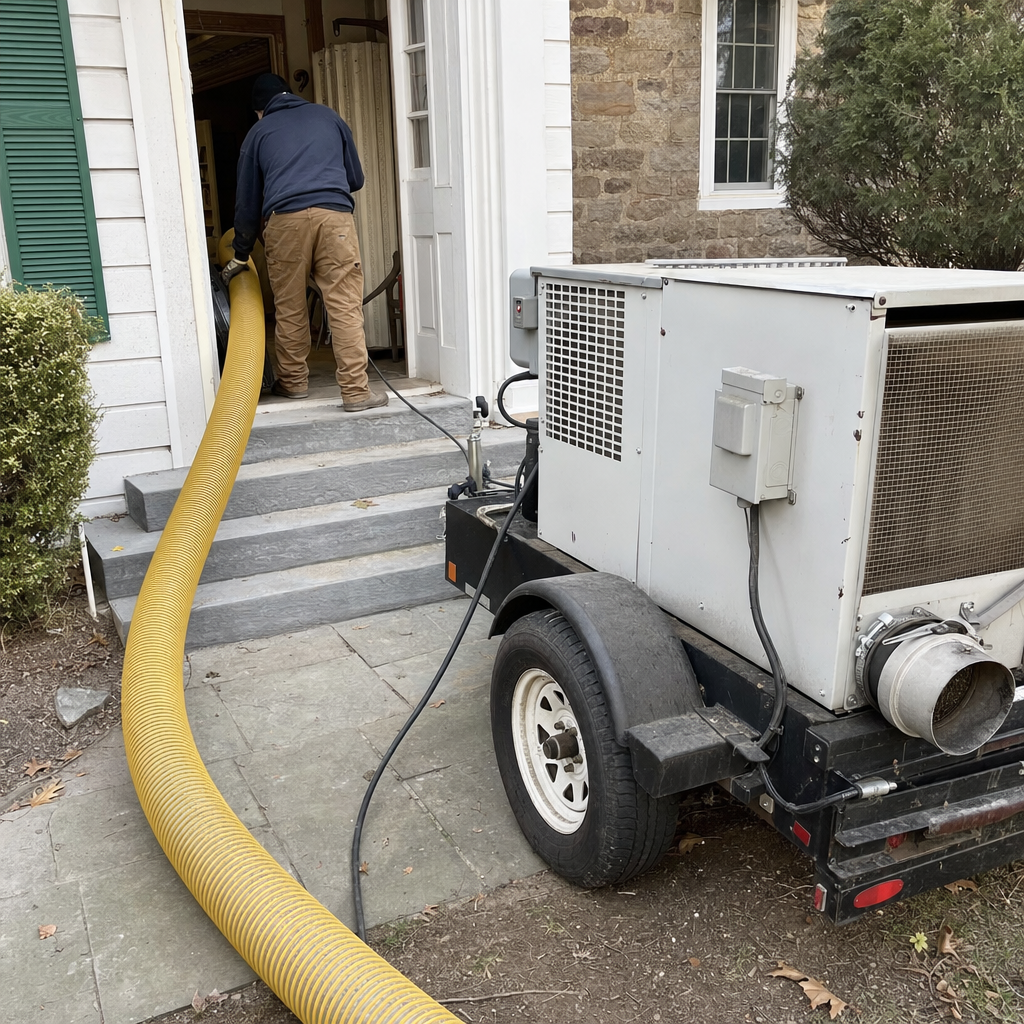
This covers what we do on 80% of our Philadelphia jobs: agitating and extracting dust, debris, and particulate from accessible supply and return ducts using brush systems and negative-air HEPA vacuums. We’re not cutting metal, changing duct sizing, or introducing chemicals that alter the system’s performance. Our Rotobrush systems and Nikro HEPA vacuums are built for this extraction work — they’re not modifying your mechanical system, they’re restoring it to its designed airflow state.
In 14 years, we’ve never pulled a building permit for straightforward duct cleaning in Philadelphia, and no municipality in Pennsylvania requires one for this scope.
Zone 2: Duct Modification (Permit Likely Required)
The moment a contractor cuts into your trunk line, adds a new supply vent, relocates a return, or seals joints with mastic in a way that changes static pressure, they’ve crossed into alteration territory. Under the UCC, mechanical alterations affecting airflow capacity require permits and inspection in virtually every Pennsylvania municipality.
We’ve seen this trip up homeowners in two common scenarios:
- Adding a basement finish: A homeowner in South Philadelphia hired a general contractor to finish their basement, who subcontracted “duct cleaning” that included cutting new supply lines. No permit was pulled. When the homeowner sold three years later, the buyer’s inspector flagged unpermitted mechanical work, forcing a $2,400 retroactive permit and inspection process.
- “Duct sealing” that reroutes airflow: Some companies market duct sealing as cleaning-adjacent, but if they’re closing off runs or changing register locations, that’s modification.
Zone 3: Mold or Contamination Remediation (Licensed Contractor or Certified Abatement Required)
This is where Pennsylvania’s regulatory framework gets serious — and where we’ve seen the most homeowner harm from uninformed contractors.
If mold growth exceeds 10 contiguous square feet inside ductwork or on associated insulation, or if asbestos-containing materials are disturbed, the work exits the “cleaning” exemption entirely. Pennsylvania Act 130 requires mold remediation contractors to hold specific licensure. Asbestos abatement requires EPA certification and DEP notification. Lead-safe practices trigger RRP (Renovation, Repair, and Painting) rules under federal EPA guidelines.
The critical distinction: a duct cleaner can identify mold during a cleaning. They cannot remediate it legally without the proper credentials — and if they disturb it without containment, they’ve made the problem worse, not better.
Pennsylvania’s Act 130: What It Means for Mold in Your Ducts
In 2008, Pennsylvania passed Act 130, creating the Mold Remediation Registration Act. Unlike some states that regulate mold loosely or not at all, Pennsylvania established a registration system requiring contractors who “perform mold remediation” to complete DEP-approved training and carry liability insurance specific to the work.
Here’s what this means practically for Philadelphia homeowners:
- Registration is mandatory, not optional: Any contractor who removes, cleans, sanitizes, or treats mold-contaminated materials for compensation must appear on the DEP’s Mold Remediation Contractor Registry. We’ve checked this registry before referring clients to remediation specialists — and we’ve seen unregistered “duct cleaners” offer mold treatment on the spot.
- The 10-square-foot threshold: Act 130 applies to “areas of mold contamination greater than 10 square feet.” Below this, general cleaning principles apply. But in ductwork, 10 square feet adds up quickly — a section of flex duct with mold on its interior surface, or insulation wrapped around a trunk line, easily exceeds this.
- Documentation requirements: Registered remediation contractors must provide written work plans, containment protocols, and post-remediation verification. This paperwork becomes part of your property’s permanent record — which matters enormously for disclosure, as we’ll cover later.
We’ve been on jobs in Northeast Philadelphia where a homeowner’s previous “duct cleaning” included a $400 “mold treatment” with no written protocol, no containment, and no contractor registration number. When the homeowner later developed respiratory symptoms and hired an industrial hygienist, the unverified treatment became a liability issue with their insurance carrier. The original contractor had vanished.
Our standard practice at Bluepeak: if we encounter visible mold during a cleaning, we stop, document with photographs, and explain the Act 130 pathway. We do not treat mold. We’re not registered for remediation, and we won’t put our customers in legal or health jeopardy by pretending otherwise.
How Allegheny County and Philadelphia County Differ
Pennsylvania’s state codes set the floor, but counties and municipalities build on top of it. For duct-related work, Allegheny County and Philadelphia County diverge in ways that matter if you own property in either jurisdiction — or if you’re comparing contractor practices across the state.
Philadelphia County: Department of Public Health Oversight
Philadelphia operates its own Department of Public Health with environmental health divisions that enforce indoor air quality standards more aggressively than many Pennsylvania counties. The city’s Air Management Services division reviews complaints related to mechanical ventilation systems in multi-family buildings, and the Department of Licenses & Inspections (L&I) maintains active permitting for mechanical alterations.
Specific Philadelphia considerations we’ve encountered:
- Row house shared walls: In Philadelphia’s dense row house neighborhoods — Passyunk, Kensington, West Philly — ductwork often runs through party walls. Any modification affecting fire separation or structural integrity requires L&I permitting, and contractors must carry Philadelphia-specific licenses for mechanical work.
- Historic district review: Properties in Rittenhouse Fitler, Society Hill, or other historic districts may require Philadelphia Historical Commission review if ductwork modifications affect interior or exterior character-defining features — even something as seemingly minor as exterior vent termination changes.
- Multi-family buildings: Philadelphia’s Department of Public Health actively inspects ventilation in apartment buildings and condominiums. We’ve assisted property managers in Center City buildings where health department orders mandated duct cleaning and documentation as part of indoor air quality remediation.
Allegheny County: Municipal Fragmentation
Allegheny County presents the opposite challenge: 130 municipalities, each with its own building code enforcement. Pittsburgh itself follows the UCC with standard permitting, but surrounding boroughs and townships vary in inspection rigor and mold remediation oversight.
We’ve worked with property managers in Carnegie and surrounding communities where the critical issue isn’t county-level regulation but municipal licensing of contractors. Some Allegheny County municipalities require business privilege licenses and proof of insurance for any mechanical contractor, while others enforce minimally. The Pittsburgh Regional Building Code applies in the city proper, but contractors working in Mt. Lebanon, Bethel Park, or Robinson Township face different inspection schedules and fee structures.
For homeowners, this means: verify your contractor’s licensing at the municipal level, not just state registration. A mold remediator registered under Act 130 still needs proper municipal licensing to pull permits for duct modifications in your specific borough.
The Documentation You Must Keep After Any Duct Work
After 14 years and over 1,100 jobs, we’ve learned that the work itself is only half the value — the paper trail protects you for years. Here’s what we provide and what you should demand from any contractor whose work touches contamination or modification:
- Pre-work photographic documentation: Before we begin any cleaning where mold, heavy debris, or deteriorated materials are visible, we photograph the condition. These images establish baseline conditions and protect both parties if questions arise later.
- Written scope of work: For standard cleaning, this details exactly which vents were serviced, equipment used (we specify our Rotobrush and Nikro systems), and any access limitations. For work touching modification or contamination, this expands to include materials to be disturbed, containment measures, and disposal methods.
- Equipment and chemical specifications: If any antimicrobial, sealant, or coating is applied, you must receive the product name, manufacturer, EPA registration number if applicable, and Safety Data Sheet. We’ve seen homeowners in Philadelphia unable to verify what was sprayed in their ducts because the contractor used unlabeled bulk chemicals.
- Post-work verification: For standard cleaning, this includes after-photos and airflow measurements where relevant. For remediation-adjacent work, demand third-party post-remediation verification — an independent assessment confirming clearance criteria were met.
- Contractor credentials: Keep copies of Act 130 registration (for mold work), municipal licenses, certificates of insurance, and any asbestos or lead abatement certifications. We provide our insurance certificate and business license with every proposal; any contractor who hesitates should raise immediate concern.
Store these documents with your property records, not in a file you’ll misplace. When we’ve helped Philadelphia homeowners prepare for sale, the ones with organized documentation moved through inspection smoothly; those with gaps faced buyer requests for re-inspection, price reductions, or contract contingencies.
Pennsylvania Disclosure Obligations When Selling
Pennsylvania’s Real Estate Seller Disclosure Law (68 P.S. § 7301 et seq.) requires sellers to complete a Property Disclosure Statement addressing known material defects. The form explicitly asks about “water or moisture problems” and “presence of hazardous substances” — categories that encompass documented mold contamination and asbestos disturbance.
Here’s where duct work documentation becomes legally consequential:
- Known remediation must be disclosed: If you hired a contractor who provided written documentation of mold remediation in your duct system, that knowledge is discloseable. Failing to disclose documented remediation can expose sellers to post-sale liability under Pennsylvania’s misrepresentation standards.
- Undocumented “treatments” create gray areas: If a duct cleaner sprayed something they called “mold inhibitor” without paperwork, you may technically lack “knowledge” of remediation — but a buyer’s inspector who finds residual staining or chemical residue will flag it, and your lack of documentation becomes a red flag itself.
- Pre-1980 properties face heightened scrutiny: Philadelphia’s housing stock includes vast pre-1980 construction where asbestos-containing duct insulation and lead paint are presumed present until tested. Sellers in neighborhoods like Germantown, Frankford, or Port Richmond should expect buyer due diligence on these materials; documentation of proper handling protects your position.
We’ve consulted with real estate attorneys in Philadelphia on cases where improper duct “remediation” became a disclosure nightmare. The pattern is consistent: a low-cost contractor offered quick treatment, provided no paperwork, and the homeowner faced a choice between expensive re-remediation with proper documentation or risking nondisclosure liability.
Our advice, grounded in what we’ve observed: if your ducts have had any contamination issue, invest in proper documentation from the start. The cost of doing it right once is always less than the cost of doing it twice — or defending against a lawsuit.
Pre-1980 Construction: Asbestos and Lead Paint Risks
Philadelphia’s housing inventory is among the oldest in major American cities. In neighborhoods from Queen Village to Brewerytown, we regularly encounter duct systems wrapped in asbestos-containing insulation or running through walls with lead-painted surfaces. These materials don’t create hazard until disturbed — but duct cleaning, if done aggressively or without proper assessment, can disturb them.
Asbestos in ductwork: Pre-1980 duct insulation, particularly the white or gray woven wrapping on metal trunk lines, often contains chrysotile asbestos. EPA regulations under NESHAP (National Emission Standards for Hazardous Air Pollutants) require notification before disturbing friable asbestos in quantities that could exceed regulatory thresholds. For residential buildings with fewer than four dwelling units, notification requirements vary by quantity, but the safe course is always: test before disturbing, and if asbestos is present, use certified abatement contractors.
Lead paint: EPA’s RRP Rule requires lead-safe practices when disturbing painted surfaces in pre-1978 housing. Duct cleaning typically doesn’t disturb painted surfaces directly, but access panel cutting, register replacement, or wall penetration for duct modification does trigger RRP requirements.
We’ve developed protocols for Philadelphia’s older housing stock: visual assessment of insulation condition before agitation, refusal to disturb deteriorated materials without testing, and clear communication to homeowners when we identify materials that require specialized handling. Our equipment — Rotobrush systems with controlled brush aggression, Nikro vacuums with proper filtration — is selected to clean effectively without unnecessary force that could liberate hazardous materials.
The contractor who tells you “it’s fine, we do this all the time” without assessing for asbestos or lead is not being reassuring — they’re being reckless, and you’re assuming the liability.
Choosing a Contractor Who Understands the Line
After 14 years focused exclusively on air ducts and indoor air quality, we’ve developed a clear sense of what separates contractors who protect their customers from those who create future problems. Here’s what to verify:
- Scope clarity in writing: The proposal should explicitly state whether work includes modification, remediation, or cleaning-only. Vague language like “complete duct restoration” without definition is a warning sign.
- Willingness to stop for contamination: A contractor who encounters mold and immediately offers to “treat it” as an add-on, rather than stopping to discuss Act 130 requirements, is prioritizing revenue over compliance. We stop, document, and refer — every time.
- Equipment specificity: Professional-grade tools for this work have names. Our Rotobrush brush-agitation systems, Nikro HEPA-rated vacuums, and Abatement Technologies containment tools are industry-standard equipment — not shop vacs with HEPA bags jury-rigged to duct hoses.
- Personal accountability: Jeffrey Morgan — owner and lead technician — handles your job personally. When the person accountable for the business is the same person on-site, the incentive alignment is clear. We don’t send rotating crews or subcontractors whose training and judgment we can’t verify.
- Documentation discipline: Ask what paperwork you’ll receive. If the answer is a handwritten receipt, that’s insufficient for work touching any regulated material.
Over 1,100 verified customers have reviewed this work, and the pattern in feedback that matters most to us isn’t star rating — it’s the number of homeowners who mention feeling informed rather than pressured. That’s the standard we apply when we refer to remediation specialists, too: we only refer contractors whose documentation practices and licensing we’d trust in our own homes.
Common Mistakes to Avoid
- Assuming “duct cleaning” covers everything: In Philadelphia’s competitive market, some companies use “cleaning” as a catch-all that includes mold treatment, sealant application, or even minor modifications. Demand written scope separation — what’s cleaning, what’s extra, and what requires different licensing entirely.
- Accepting verbal mold assessments: A contractor who says “you’ve got mold” without photographic documentation or lab confirmation is making a medical-adjacent claim without evidence. We’ve seen homeowners pay for unnecessary “treatments” based on discoloration that was actually rust, dust staining, or fiberglass erosion.
- Ignoring municipal licensing: A state-registered mold remediator still needs proper Philadelphia L&I licensing to pull mechanical permits. Verify both levels, especially in row house neighborhoods where party wall work triggers additional requirements.
- Discarding documentation: The work order you toss in a drawer today becomes the missing link in your home sale disclosure five years from now. We provide digital and physical copies of all documentation specifically for this long-tail need.
- Hiring based on lowest bid for contamination work: Proper mold remediation with Act 130 compliance, containment, and post-verification costs more than spraying chemicals into a duct. The low bid often reflects corner-cutting that creates liability — and we’ve been called in to document the aftermath for insurance disputes.
- Failing to test pre-1980 materials: In Philadelphia neighborhoods with century-old housing, assume asbestos-containing materials until proven otherwise. The $200–$400 testing cost is trivial against abatement liability or health exposure.
- Confusing sanitizing with remediation: Our air sanitizing service — applying EPA-registered antimicrobials to cleaned duct surfaces — is a maintenance step, not a mold remediation solution. Any contractor who blurs this distinction is misrepresenting regulatory scope.
When to Call a Professional
Call a specialist when you observe visible mold inside vents or registers, when your home was built before 1980 and duct insulation appears deteriorated, when you’re preparing to sell and lack documentation of prior duct work, or when a previous cleaning included “mold treatment” without written protocols. These aren’t cleaning scenarios — they’re assessment and potential remediation scenarios requiring credentials beyond standard duct cleaning.
For straightforward duct cleaning, HVAC cleaning, or dryer vent cleaning where no contamination is suspected, professional service restores system performance without regulatory complexity. Bluepeak Air Duct & Vent Cleaning Pennsylvania offers free estimates in Philadelphia — call (844) 951-3591. Jeffrey Morgan handles each assessment personally, and if we encounter conditions requiring remediation or modification beyond our scope, we’ll document what we found and explain your pathway forward.
Frequently Asked Questions
No — standard air duct cleaning that removes debris from accessible vents and ducts without cutting, modifying, or extending the system does not require a building permit in Philadelphia or anywhere in Pennsylvania. However, if the work includes duct modification, mold remediation, or disturbance of asbestos-containing materials, permitting or specialized contractor licensing applies. Call (844) 951-3591 for a free estimate on cleaning-only scope — we’ll assess whether your situation stays in the no-permit zone.
Most residential duct cleaning in Philadelphia ranges from $400 to $800 for a typical single-family home, depending on system size, accessibility, and contamination level. Homes with multiple HVAC zones, finished basements with limited access, or heavy post-renovation debris fall at the higher end. We provide upfront pricing before beginning work — estimates are free.
Stop the cleaning and request documentation. Under Pennsylvania Act 130, mold remediation exceeding 10 square feet requires a DEP-registered contractor with specific training and insurance. A standard duct cleaner who offers to “treat” mold on the spot without registration, containment protocols, or written work plans is operating outside legal requirements and creating liability. We photograph what we find, explain the Act 130 pathway, and refer to registered remediators we’ve vetted.
Yes — if the remediation was documented. Pennsylvania’s Seller Disclosure Law requires disclosure of known material defects, including water/moisture problems and hazardous substances. Documented mold remediation in your duct system falls within these categories. Undisclosed known remediation can expose you to post-sale liability. Proper documentation from a registered remediator actually protects you by demonstrating the issue was professionally addressed.
Search the Pennsylvania Department of Environmental Protection’s Mold Remediation Contractor Registry online. Request the contractor’s registration number and cross-check it against the active list. Registration confirms completed training and required insurance — it’s not optional for legal mold remediation in Pennsylvania.
No — not without EPA certification and proper DEP notification. Asbestos abatement is a separate regulatory category from duct cleaning. If your pre-1980 Philadelphia home has deteriorated white or gray woven insulation on ductwork, any disturbance requires testing and, if positive, certified abatement. We identify suspect materials, stop work, and direct you to certified professionals.
The Bottom Line
Pennsylvania’s regulatory framework around duct work is navigable once you understand the boundary: cleaning restores what’s there, modification changes what’s there, and remediation addresses contamination — and only cleaning sits comfortably in the unpermitted zone. For Philadelphia homeowners, the stakes are heightened by older housing stock, active municipal enforcement, and disclosure obligations that turn today’s undocumented treatment into tomorrow’s sale complication. The contractors who protect you are those who know the line, respect it, and document their work. After 14 years focused on one trade, we’ve learned that the most valuable service we provide isn’t always the cleaning itself — it’s the judgment to stop when conditions exceed our scope, and the clarity to explain why.
Written by Jeffrey Morgan, Owner & Lead Technician at Bluepeak Air Duct & Vent Cleaning Pennsylvania, serving Philadelphia since 2012.