
Signs You Need Dryer Vent Cleaning in Pennsylvania: The Warning Signals Most Homeowners Misread
If your clothes take more than one cycle to dry, your laundry room feels unusually hot, or your exterior vent flap barely flutters when the dryer runs, you almost certainly need dryer vent cleaning. These three signs share one mechanical root: restricted airflow from lint accumulation that forces your dryer to work harder, run hotter, and exhaust poorly. In Pennsylvania’s older housing stock — with row-home laundry closets, long vent runs, and decades-old flexible ductwork — these symptoms often appear earlier and progress faster than in newer construction elsewhere. Call (844) 951-3591 if you’re seeing any of them now; we’ll diagnose it on-site and give you a straight answer.
The Vent Flap Test: The Sign Jeffrey Morgan Catches First
Jeffrey Morgan — owner and lead technician at Bluepeak Air Duct & Vent Cleaning Pennsylvania — has a simple diagnostic he runs before anything else. Go outside while your dryer is running on high heat and watch the exterior vent flap. It should blow open fully and stay there, with warm, forceful airflow you can feel from a foot away. If it barely lifts, flaps weakly, or doesn’t open at all, you’ve got a blockage.
Here’s what most Pennsylvania homeowners miss: the gradual adjustment. You start running the dryer for an extra ten minutes. Then you split heavy loads. Eventually you’re running two full cycles for towels that used to dry in one, and you’ve convinced yourself the dryer’s just getting old. Jeffrey has pulled compacted lint blockages from vents in Lawrenceville row homes and Squirrel Hill duplexes where the dryer was “seemingly fine” by this degraded standard — and where the homeowner was weeks away from a thermal overload shutoff or worse.
The vent flap test works because it measures what actually matters: exhaust velocity. Your dryer’s blower motor is designed to push air through a specific resistance. When lint accumulates — especially at the low points of sagging flexible duct or at 90-degree elbows common in tight Pennsylvania laundry closets — backpressure builds. The blower can’t overcome it. Less air moves through the drum, less moisture gets carried away, and the high-limit thermostat cycles the heating element on and off more aggressively. That’s your longer dry time and your hotter laundry room, both from the same root cause.
Pennsylvania Installation Patterns That Accelerate the Problem
Not all dryer vent systems age at the same rate. In fourteen years of focused duct and vent work across Pennsylvania, we’ve identified three local installation patterns that make lint accumulation happen faster and make warning signs more urgent when they appear — which is why finding Best Dryer Vent Cleaning in Pennsylvania, PA matters for your specific setup.
Rear-Exit Dryers in Row-Home Laundry Closets
The classic Pittsburgh row home or Philadelphia townhouse often has the washer and dryer tucked into a converted closet or narrow rear addition. The dryer vents straight back into a wall cavity with minimal clearance. There’s no room for the recommended four-inch rigid metal duct. Instead, installers — often decades ago — used vinyl or thin aluminum flex duct, compressed into sharp bends. Every bend is a velocity drop. Every compression point is where lint settles. In neighborhoods like Bloomfield, East Liberty, and parts of Allentown, we regularly find flex duct that’s essentially formed a lint dam at the first elbow.
Long Horizontal Runs to Soffit or Side-Wall Exits
When the dryer can’t vent through the roof or a nearby gable end, the run goes horizontal — sometimes twenty or thirty feet through a basement ceiling or crawlspace. Pennsylvania’s freeze-thaw cycles and humid summers compound the problem: any slight sag in that long run creates a low point where condensation collects, lint sticks, and a blockage forms progressively. We’ve extracted fully compacted lint “logs” from horizontal runs in State College and Harrisburg ranch homes where the homeowner had no idea the vent path was that long.
Older Aluminum Flex Duct (Not Rigid Metal)
Pre-1990s installations across Pennsylvania heavily favored corrugated aluminum flex duct. It’s cheap, it’s flexible, and it’s terrible for dryer vents. The corrugations slow airflow and trap lint at every ridge. Over years, the duct sags between supports — especially in unfinished basements where it was hung with inadequate straps. Those sags become collection points. The duct itself degrades, developing tears that leak lint into wall cavities or basement air. When we replace this with proper rigid metal duct during a Dryer Vent Cleaning service, the improvement in airflow is immediate and measurable.
From Partial to Full Blockage: The Spectrum Most Pages Don’t Explain
Understanding where you are on the blockage spectrum matters because it determines what you’re risking and how urgently you need service.
| Blockage Stage | What You’ll Notice | What’s Actually Happening | Risk Level |
|---|---|---|---|
| Partial — Early | One extra cycle for heavy loads; slight warmth in laundry room | Lint accumulation reducing airflow 20–40%; dryer sensor reading damp clothes as dry due to lint insulation | Efficiency loss, utility cost increase |
| Partial — Moderate | Consistent multi-cycle drying; hot laundry room; musty smell on “dry” clothes | Airflow reduced 50–70%; exhaust backing up into drum and room; condensation forming in vent from humid air | Heat stress on dryer components; mold risk in vent; fire hazard developing |
| Near-Full | Dryer shuts off mid-cycle on thermal overload; burning smell; exterior flap barely moves | Airflow reduced 80–90%; high-limit thermostat cycling or failing; lint near ignition temperature | Significant fire hazard; dryer damage likely |
| Full Blockage | No exterior airflow; dryer won’t stay running; visible lint at vent opening | Complete obstruction; blower motor straining; potential duct rupture or fire | Immediate fire and safety emergency |
The musty smell deserves particular attention because it’s mechanically distinct. When humid exhaust air can’t escape freely, it condenses inside the partially blocked vent. That moisture mixes with lint — which is organic material, remember, mostly cotton and cellulose fibers — and you get microbial growth. Your “dry” clothes come out smelling like a damp basement because they were essentially steam-dried in humid air. We’ve had Pennsylvania homeowners replace their dryers twice before realizing the vent was the culprit.
Seasonal and Exterior Signs: Pennsylvania’s Bird-Nest Problem
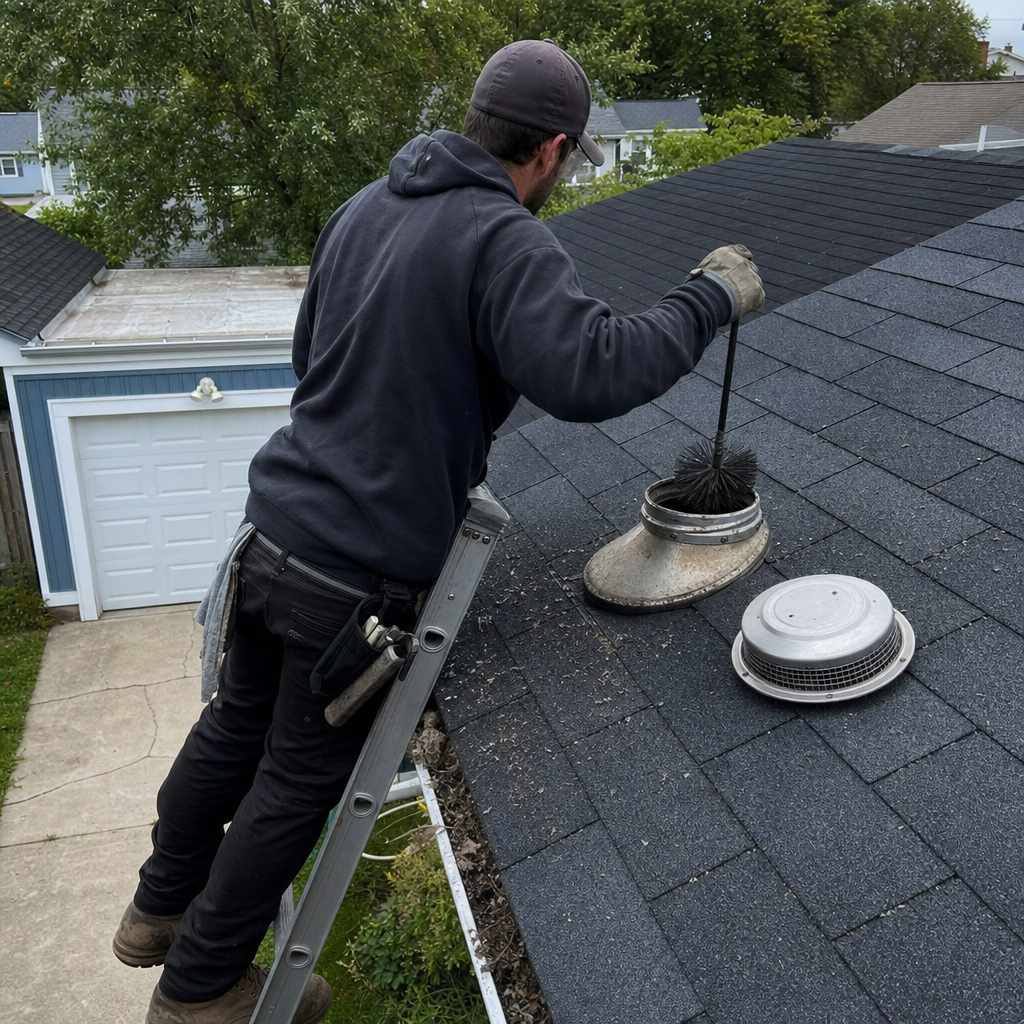
Spring in Pennsylvania brings a specific hazard that generic “signs” pages never mention. Our cavity-nesting birds — house sparrows, starlings, occasionally chimney swifts — treat uncovered or damaged vent caps as ready-made nesting sites. Jeffrey has cleared nests from exterior vent caps in early May across Allegheny County, Montgomery County, and the Lehigh Valley. The pattern is consistent: homeowner runs the dryer after months of line-drying, notices immediate poor performance or a shutoff, and finds the vent cap completely sealed with twigs, grass, and nesting material.
This isn’t a gradual lint accumulation. It’s a rapid full blockage with a live fire hazard — the nest itself is dry and flammable, and the dryer’s heating element is right behind it. If your vent cap has missing flappers, no bird guard, or visible gaps, that’s a pre-condition for this failure. We install proper guards as part of our cleaning service where needed.
Other exterior signs to watch:
- Lint accumulation on your siding or foundation below the vent exit — means exhaust is escaping through a vent tear or disconnection
- Visible lint “fuzz” around the exterior cap even when the dryer hasn’t run recently — indicates a partial blockage pushing lint backward
- Ice buildup on the exterior cap in winter — means moist exhaust is escaping slowly and freezing, a sure sign of restricted flow
When “I Just Had It Cleaned” Becomes Its Own Warning Sign
Here’s where equipment specificity matters. We hear this regularly: “Another company cleaned it two years ago, but the problems came back in six months.” Sometimes that’s normal lint accumulation in a high-use household. Often, it’s incomplete work from inadequate tools.
A brush-rod-only cleaning — the flexible rods with a brush head that many generalist services use — has limitations. In a straight or gently curved rigid metal duct, it works adequately. In Pennsylvania’s typical installations with multiple elbows, sagging flex duct, or long horizontal runs, a brush rod pushes lint forward until it hits a restriction, then packs it tighter. It doesn’t extract. It redistributes.
Our approach combines Rotobrush brush-agitation systems with Nikro HEPA-rated vacuum extraction under negative pressure. The brush loosens adhered lint from duct walls; the vacuum pulls it out of the system entirely, contained so it doesn’t re-enter your home. For severe blockages, we use Abatement Technologies containment tools to isolate sections and extract compacted material that brush-rods simply can’t reach. If I wouldn’t run it in my own house, I won’t recommend it in yours.
The sign of previous incomplete work is usually this: your dry time improved briefly, then degraded faster than it should. The brush packed lint into a elbow or low point; that packed lint became a new collection surface; accumulation accelerated. A proper extraction cleaning removes the material entirely and restores design airflow.
Common Local Scenarios: When Pennsylvania Homeowners Call Us
These are the situations we encounter most — not abstract symptoms, but real contexts that should prompt you to pick up the phone.
The recent home purchase. You bought a Pittsburgh-area row home or a 1970s split-level in the suburbs. The inspection noted “dryer vent appears functional.” Functional doesn’t mean clean, and in a property that sat vacant or had tenants who didn’t maintain it, we often find years of accumulation. One new homeowner in Mt. Lebanon called us when her dryer shut off on thermal overload in the first month — the vent hadn’t been cleaned in eleven years.
The renovation aftermath. You remodeled your kitchen or finished your basement. Construction dust is fine particulate; it coats everything, including the interior of ductwork. If your laundry area was part of the work zone, or if the HVAC ran during construction, that dust loads your dryer vent faster than normal lint alone. We recommend vent cleaning after any major renovation, especially in older Pennsylvania homes where the vent system was already marginal.
The allergy or asthma household. Jeffrey’s own daughter had asthma, which is part of why he gravitated to this work. A blocked dryer vent doesn’t just affect laundry efficiency — it pressurizes the system and can force lint and moisture into wall cavities and living spaces. For someone with respiratory sensitivity, that’s a genuine indoor air quality issue, not a convenience problem.
The “it’s always been slow” inheritance. You moved into a home where the previous owner accepted two-cycle drying as normal. You’ve never known anything different. This is the most common call we get for full-blockage emergencies — the system was always compromised, and eventually it failed completely. Don’t inherit someone else’s degraded standard.
What Professional Dryer Vent Cleaning Actually Involves
When you call Bluepeak at (844) 951-3591, here’s what happens. Jeffrey Morgan arrives as lead technician — the same person who owns the business and answers for the outcome. We inspect the full vent path from dryer to exterior, identify your specific installation type and any damage, and clean using equipment matched to the job: Rotobrush agitation for adhered buildup, Nikro HEPA extraction for removal, Abatement Technologies containment where needed. We measure airflow before and after so you have verification, not just a claim.
If we find damaged ductwork, we can repair or replace with rigid metal where appropriate — part of our full service scope that includes home air duct cleaning, HVAC cleaning, duct repair and sealing, and air quality solutions through Honeywell and Aprilaire products. One call, one accountable technician, no subcontractor handoffs.
Key Takeaways: When to Call for Dryer Vent Cleaning in Pennsylvania
- Run the vent flap test: weak or no movement means blockage, regardless of dry time
- Longer dry times, hot laundry rooms, and musty smells are progressive stages of the same airflow restriction
- Pennsylvania’s older flex-duct installations and long vent runs accelerate problems — don’t compare your timeline to national averages
- Spring bird nesting can create sudden full blockages; inspect your exterior cap seasonally
- Previous “cleaning” that didn’t last likely used inadequate extraction equipment
- Partial blockages become full blockages; the cost difference between scheduled maintenance and emergency service is significant
FAQs
How Much Does Dryer Vent Cleaning Cost? (2026 Price Guide) — Pennsylvania, PA: typically $120 to $250 for standard residential service, depending on vent length, accessibility, and whether the installation uses rigid metal or flexible duct that requires more time to clean properly. Homes with long horizontal runs through finished basements, multiple elbow transitions, or bird-nest blockages at the exterior cap fall toward the higher end. Call (844) 951-3591 for an exact quote — estimates are free, and we’ll diagnose your specific vent configuration on-site.
DIY dryer vent cleaning kits cost $20–$40 but carry real limitations and risks: brush rods can pack lint deeper into elbows, damage flexible duct, or disconnect joints you can’t see in wall cavities. For Pennsylvania’s typical installations with multiple bends and older flex duct, Affordable Dryer Vent Cleaning in Pennsylvania, PA with professional extraction equipment pays for itself in prevented dryer damage, fire risk reduction, and actual airflow restoration. If you’d rather have it assessed properly, Bluepeak Air Duct & Vent Cleaning Pennsylvania offers no-pressure inspections — call (844) 951-3591.
Most Pennsylvania homes need dryer vent cleaning every 12 to 18 months, though households with heavy use, pets that shed, or older flexible duct installations may need service annually. The specific factors that shorten this interval in our region include: long vent runs common in row homes and split-levels, corrugated flex duct that traps lint, and seasonal bird activity that can block exterior caps suddenly. After our service, we’ll tell you honestly whether your installation warrants annual or biennial maintenance based on what we found.
Yes — we prioritize calls where the dryer is cycling on thermal overload or showing signs of near-full blockage, because these are active fire hazards. Same-day service is often available for Pennsylvania homeowners in our service area; call (844) 951-3591 and we’ll tell you honestly whether we can reach you today or if you should stop using the dryer immediately until we do. Safety comes before scheduling.
If you’d rather have it looked at, Bluepeak Air Duct & Vent Cleaning Pennsylvania offers a no-pressure assessment in Pennsylvania — call (844) 951-3591.
Written by Jeffrey Morgan, Owner & Lead Technician at Bluepeak Air Duct & Vent Cleaning Pennsylvania, serving Pennsylvania, PA.