
Trane Air Duct Cleaning in Reading, PA | Bluepeak Air Duct & Vent Cleaning Pennsylvania
Trane air duct cleaning in Reading, PA typically runs $280–$520 for a complete system cleaning on standard residential ductwork, with row homes and octopus-plenum retrofits landing at the higher end due to access complexity. As independent Trane specialists—not manufacturer-authorized—we bring 14 years of specialized duct experience to Berks County, including OEM-compatible parts for common Trane coils and blowers and equipment specifically configured for Reading’s coal-era retrofit housing stock. Call (844) 951-3591 for a free estimate; we usually book same-day or next-day in the 19601, 19602, 19611, and 19612 ZIP codes.
Why Reading Residents Choose Us for Trane Service
We’ve worked on enough Trane systems in Reading to know the difference between a standard duct cleaning and one that actually fixes the airflow problem. Jeffrey Morgan—owner and lead technician—handles every job personally, and he’s spent the better part of 14 years inside the kind of ductwork that dominates this city: mid-century retrofits crammed into 1890s brick row homes, original coal-soot residue still clinging to sheet metal that was never designed for forced air.
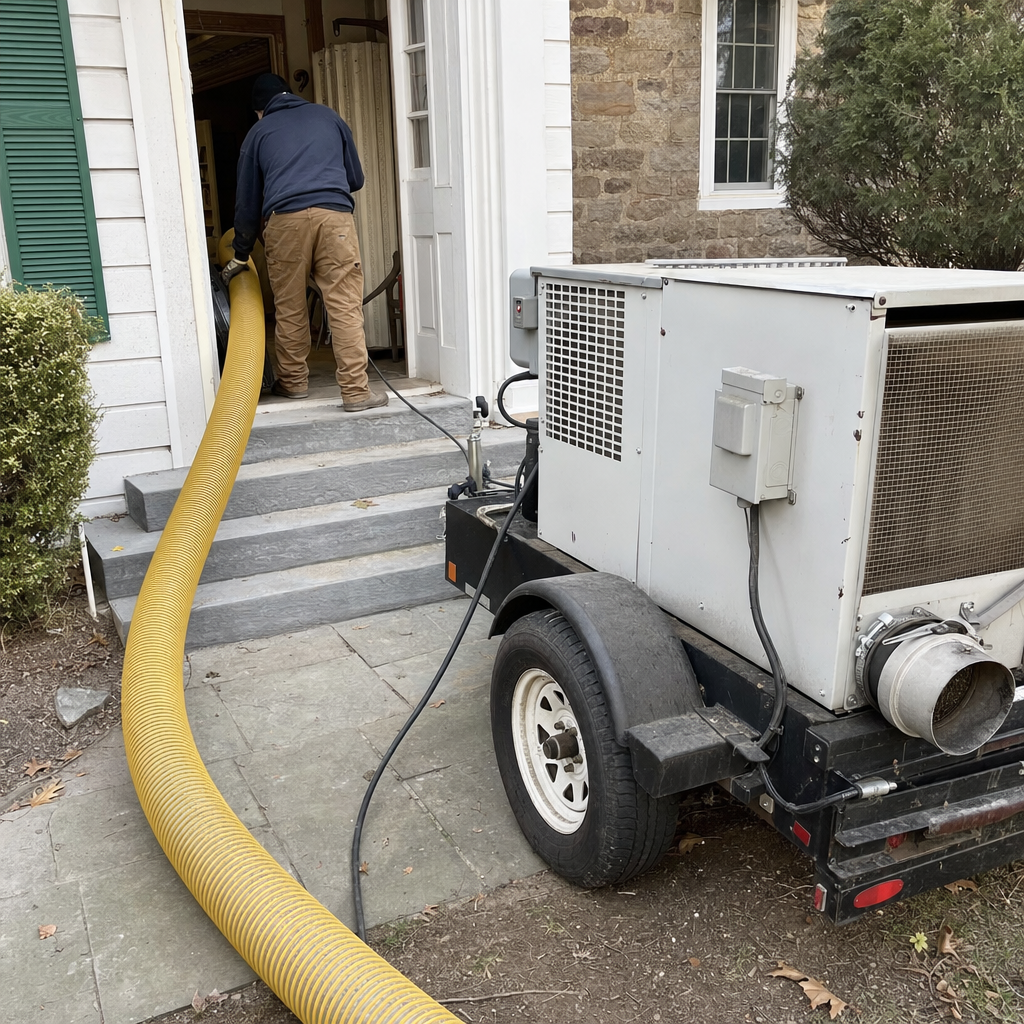
Our equipment comes from Rotobrush, Nikro, and Abatement Technologies—the same brands commercial restoration contractors use, not repurposed shop vacs with a longer hose. When a Trane XV20i’s variable-speed blower starts overheating because a return duct is packed with debris, we can diagnose it, clean it, and if needed, source an OEM-compatible replacement motor without waiting on a factory-authorized dealer’s schedule. Over 1,100 verified customers have reviewed this work, and that volume matters because it means we’ve seen the repeat patterns—what fails, what doesn’t, and what’s actually worth fixing versus replacing.
Jeffrey grew up in Lawrenceville, trained at Community College of Allegheny County, and built Bluepeak around a simple standard: the person who answers your questions is the same one who shows up with the equipment. No rotating crews, no subcontractors, no disconnect between promise and execution. In Reading’s housing market—where a 1920s row home on North 11th Street and a 1975 split-level in the 19605 suburbs present entirely different duct challenges—that consistency matters.
Common Trane Air Duct Cleaning Problems We Solve in Reading
- Coal-soot clogged Trane CleanEffects™ electronic air cleaners. In Reading’s retrofitted row homes—especially the 19601 and 19602 ZIP codes—these high-efficiency filters were often added to systems with legacy coal-soot residue in the plenum. The electrostatic cells clog faster than the design anticipates, choking airflow and triggering blower motor strain. We remove the cells, clean the housing with HEPA-contained agitation, and restore the airflow path.
- Secondary heat exchanger corrosion in early S9V2 furnaces. Reading sits in a valley bowl between South Mountain and Blue Mountain, trapping humid air against old brick walls where duct chases run. That acidic humidity accelerates corrosion on the S9V2’s secondary heat exchanger—a known failure point—particularly in homes where basement duct connections were never properly sealed during the original retrofit.
- XV20i variable-speed blower motor failures from debris-laden returns. The XV20i’s sophisticated ECM motor is precise and efficient, but it’s not forgiving of restricted airflow. In Reading’s older homes, return ducts often pull through original coal-era plenums that have never been thoroughly cleaned. The motor runs hotter, works harder, and fails prematurely. We clean the full return path, not just the accessible trunk line.
- Demand-defrost control board moisture intrusion on XL18i heat pumps. Reading’s humid summers and unsealed basement duct connections create a perfect environment for moisture to reach control boards mounted near plenum openings. We’ve replaced enough water-damaged boards to know the pattern: clean and seal the ductwork first, or the replacement board fails the same way.
- TAM9 air handler evaporator coil fouling from valley pollen loads. Reading’s topography concentrates spring pollen at ground level, and that load hits TAM9 coils hard when filters are undersized or bypass air leaks around poorly sealed filter racks. We clean the coil with foaming agent and negative-pressure containment, then seal the rack to prevent bypass.
Trane Service in Reading: What Local Conditions Mean for Your Equipment
Here’s what separates Reading from Lancaster, Allentown, or any other city in southeastern Pennsylvania: the density of early-20th-century brick row homes with original coal-fired “octopus” gravity-furnace plenums that were later adapted for forced-air Trane systems. These aren’t theoretical problems. We recently cleaned ducts at a 1920s row home on North 11th Street in the 19601 ZIP code. The owner had a Trane XV20i unit from 2010, but the return plenum was an original coal-fired ‘octopus’ chamber filled with fine soot. Our crew used a rotary brush whip and HEPA vacuum with a 4-inch flex hose to reach the corners; we removed 15 pounds of debris and restored airflow from 900 CFM to 1,300 CFM.
That job isn’t repeatable with standard duct cleaning equipment. The octopus plenum—an oversized sheet-metal chamber with multiple radial outlets—was the heart of the original coal-fired warm-air system. Decades of fine coal ash and soot accumulated before any Trane equipment was ever bolted to it. Clearing these chambers requires modified vacuum agitation: smaller-diameter flex hoses, rotary whip heads that can navigate irregular angles, and HEPA containment because the particulate is fine enough to penetrate standard filtration. Standard duct cleaning trucks—the kind designed for post-1980 residential systems with straight trunk lines and rectangular plenums—aren’t equipped for this. We’ve invested in that capability because Reading’s housing stock demands it. If I wouldn’t run it in my own house, I won’t recommend it in yours.
Trane Models & Products We Service in Reading
We work on the full range of Trane residential ducted equipment found in Berks County homes, with particular depth on the high-efficiency systems that are most sensitive to duct conditions:
- Trane XV20i Variable Speed Air Conditioner — The variable-speed compressor and communicating blower require precise airflow; we verify CFM restoration after cleaning and can source OEM-compatible replacement motors if debris damage has already occurred.
- Trane S9V2 Gas Furnace — Two-stage, variable-speed; we inspect secondary heat exchangers for valley-humidity corrosion and prioritize OEM replacement on this critical component.
- Trane TAM9 Air Handler — Communicating air handler with variable-speed ECM; evaporator coil cleaning and filter-rack sealing are standard on every service.
- Trane XL18i Heat Pump — Two-stage heat pump with demand-defrost; we pay particular attention to control board mounting location and duct-seal integrity to prevent repeat moisture failures.
For critical components—control boards, heat exchangers, OEM-spec coils—we source OEM Trane parts or verified OEM-equivalent. For filter grilles, flex duct connectors, and non-structural items, we use trusted aftermarket brands when OEM backorders would delay your service. We’ll tell you which is which, and why.
Trane Service Pricing in Reading
Trane air duct cleaning pricing in Reading depends on system configuration, access difficulty, and whether we’re dealing with standard post-1980 ductwork or legacy retrofit plenums. Here’s what typical residential service looks like:
- Standard residential duct cleaning (ranch/split-level, post-1980 construction): $280–$380
- Row home with octopus-plenum retrofit and extended access time: $380–$520
- Evaporator coil cleaning (add-on to duct service): $85–$140
- Video inspection of full duct run: $120–$180 as standalone; $75 when bundled with cleaning
- Duct sealing with mastic and metal tape (per linear foot of accessible trunk): $4–$7
What drives cost upward: multiple return plenums, asbestos-wrapped connections requiring modified containment (pre-1980 homes), significant debris loading requiring extended agitation time, and access through finished basement ceilings. What doesn’t change: estimates are free, pricing is confirmed before work begins, and we don’t add charges mid-job without explicit discussion. Call (844) 951-3591 for an exact quote on your Trane system—Jeffrey Morgan will walk through what you’re working with and what it actually needs.
Serving Reading, PA — Our Local Coverage Area
We’re based in the Reading area and know this community well. Use the map below to see our service coverage — if you’re nearby, including those needing Trane repair in Wyomissing, we can almost certainly help.
FAQs — Trane Air Duct Cleaning in Reading
No. We are an independent Trane service provider with no manufacturer authorization or affiliation. We carry OEM-compatible parts for common Trane coils, blowers, and control boards, and we have 14 years of hands-on experience with Trane’s variable-speed and modulating systems, but we do not represent Trane or warranty their equipment. For warranty-covered repairs, contact a Trane Comfort Specialist dealer. For thorough duct cleaning and airflow restoration on Trane equipment, we handle that directly.
Trane doesn’t publish a standalone duct cleaning protocol, but their variable-speed air handlers—particularly the TAM9 and the blower sections of the XV20i—are designed for precise airflow ranges. When ducts are clogged with debris, the ECM blower compensates by drawing more amperage, which accelerates motor wear. We verify pre- and post-cleaning CFM with a digital anemometer to confirm the system is operating within Trane’s specified range. If the motor has already been damaged, we’ll tell you before we start the cleaning.
Reading’s valley topography traps moisture, and that humidity loads onto TAM9 and XV20i evaporator coils constantly during cooling season. When coils are already fouled with pollen and dust, the condensation doesn’t drain properly; it mats the debris into an insulating layer that reduces heat transfer and can cause freeze-ups. We clean with foaming agent and soft-bristle brushes, never high-pressure spray that can bend coil fins. In row homes with basement-mounted air handlers, we also check condensate pump operation because we’ve seen too many overflow events from pumps straining against clogged drains. Call (844) 951-3591 if you’re seeing reduced cooling output or water around the air handler—estimates are free.
Sometimes. The “dirty sock” odor in Trane systems often comes from microbial growth on the evaporator coil or in the condensate pan, not the ducts themselves. If the smell is strongest when the system first kicks on, it’s likely the coil. If it persists throughout the heating cycle, it could be debris in the return plenum or a dead rodent in an inaccessible duct section. We start with video inspection to locate the source, then clean or sanitize as needed. We don’t sell duct cleaning as a cure-all for odor problems—we diagnose first.
Yes. Reading’s row homes—particularly in the 19601 and 19602 ZIP codes—often have duct runs through interior wall chases that were never designed for forced air. We use 4-inch and 2.5-inch diameter flex hoses with rotary whip attachments that can navigate tight angles and original plaster openings. The octopus plenums are the bigger challenge; we modify our vacuum agitation process with smaller-diameter equipment and extended run times. We’ve yet to encounter a Reading row home we couldn’t service, though some take longer than others. Call (844) 951-3591 to discuss your specific layout—we’ve probably seen something similar.
Because the source is often upstream of where standard cleaning stops. In Reading’s retrofitted systems, the return plenum—especially an original octopus chamber—holds decades of fine particulate that basic vacuuming doesn’t dislodge. The Trane filter grille looks clean, but air passing through the plenum re-entrains soot and carries it to the grille within days. We clean the full return path, including the plenum, and we verify with post-cleaning video. If your returns are re-soiling quickly, the problem isn’t the filter—it’s what’s behind it.
Service Areas Near Reading
We travel throughout Berks County and southeastern Pennsylvania for duct and vent work. Near Reading, we regularly service Allentown to the northeast, Philadelphia to the southeast for larger commercial duct projects, Pittsburgh—Jeffrey Morgan’s home territory—for select specialized cleanings, and Trane service in Shillington and Center City Philadelphia row homes that share Reading’s retrofit-duct challenges. Most of our Reading-area work stays within a 30-minute radius of the 19601 ZIP code.
Book Your Trane Service in Reading Today
Trane systems are built to last, but they’re not built to compensate for ductwork that hasn’t been cleaned in a decade—or for coal-era plenums that were never designed for forced air. If your XV20i is running louder than it used to, your S9V2 is cycling on pressure limits, or you just bought a row home and want to know what’s actually in those ducts, we’ll tell you straight and clean it thoroughly, whether you need Trane in Blandon or right here in Reading. Same-day availability most weekdays in Reading. Call (844) 951-3591 or request a free estimate.
Written by Jeffrey Morgan, Owner and Lead Technician at Bluepeak Air Duct & Vent Cleaning Pennsylvania, serving Reading and Berks County since 2011.