
Emergency Air Duct Cleaning Near Me: What Philadelphia Homeowners Should Do First
If you search “emergency air duct cleaning near me” in Philadelphia, you’ll find companies promising same-day service — but true duct emergencies are rare, and calling the wrong professional first can cost you hundreds and delay the real fix. Most “urgent” duct situations actually need an HVAC technician, plumber, or remediation specialist before a duct cleaner ever steps foot in your home. Here’s how to tell what you’re really dealing with and who to call first.
If you’d rather not sort this out alone, Bluepeak Air Duct & Vent Cleaning Pennsylvania home offers free estimates — call (844) 951-3591.
Why “Emergency Duct Cleaning” Searches Usually Lead to the Wrong Fix
We’ve spent 14 years in Philadelphia attics and basements, and here’s what we’ve learned: when homeowners panic-search “emergency air duct cleaning,” they’re usually responding to symptoms, not source problems. The ductwork is the delivery system, not the culprit.
That burning smell when your heat kicks on in October? It’s almost always dust on the heat exchanger or burner assembly — an HVAC issue, not a duct issue. Visible smoke from registers? Likely an electrical problem in the furnace or a seized blower motor. Water in your basement ducts after a Center City flash flood? You need water mitigation and possibly a plumber before anyone cleans anything.
We’ve had calls from Fishtown rowhomes where a homeowner paid $400 for “emergency duct cleaning” the same day a furnace ignitor failed, only to need the HVAC tech anyway. The ducts weren’t dirty — the furnace was broken. In our experience, about seven out of ten “emergency” duct calls we field in Philadelphia turn out to be something else entirely.
The real skill isn’t cleaning fast — it’s diagnosing correctly. That’s why Jeffrey Morgan — owner and lead technician — handles assessments personally rather than sending a salesperson.
The Four “Emergency” Scenarios: A Decision Tree for Philadelphia Homes
Here’s how to sort through the most common panic calls we get, based on what we’ve seen across Philadelphia’s housing stock — from 1920s Mount Airy twins to new construction in Northern Liberties.
Scenario 1: Burning Smell When Heat Turns On
What it probably is: Dust accumulation on furnace components burning off, or a failing electrical part.
First step: Shut off the system at the thermostat and the breaker. Call an HVAC technician. Do not run the system to “burn it off” — that’s how you turn a $200 repair into a fire department visit.
When duct cleaning helps: After the HVAC repair, if the incident spread soot through the supply ducts. We can assess whether contamination reached the trunk lines or just the immediate plenum.
Scenario 2: Visible Smoke From Registers
What it probably is: Electrical failure in the air handler, or — in older Philadelphia homes with oil heat — a delayed ignition puff-back.
First step: Evacuate if smoke is heavy. Shut down at the breaker. Call the fire department if unsure, then an HVAC technician. This is not a duct problem.
When duct cleaning helps: After puff-back, professional cleaning with Rotobrush agitation and Nikro HEPA containment can remove oily soot from duct walls — but only after the combustion problem is fixed and documented for insurance.
Scenario 3: Water in Ducts After Flooding
What it probably is: Basement or crawlspace flooding that reached low return ducts, especially common in Philadelphia’s flood-prone neighborhoods like Eastwick and parts of Manayunk.
First step: Shut down the HVAC system completely — running it will aerosolize whatever’s in that water through every room. Call water mitigation. Document everything with photos and timestamps before any cleanup begins.
Critical: If the water came from a sewage backup or street flooding, assume contamination. Don’t let anyone tell you to “dry it out with the fan running.” We’ve seen homeowners in Germantown spread bacteria throughout three floors that way.
When duct cleaning helps: After drying and remediation, if the ducts themselves held standing water. We inspect with cameras to determine if sections need replacement versus cleaning.
Scenario 4: Sudden Allergy Spike or Respiratory Issues
What it probably is: Could be duct-related, but also check for gas leaks, carbon monoxide, or recent pesticide application.
First step: Rule out CO with detectors. Consider whether you’ve had recent construction, rodent activity, or a humidifier running unchecked (common in winter when Philadelphia’s dry indoor air drives over-humidification).
When duct cleaning helps: If you’ve confirmed mold growth on duct interiors, heavy rodent debris, or post-construction dust loading. We use Abatement Technologies containment to prevent cross-contamination during cleaning.
What to Do in the First Hour After Flooding Reaches Your Ducts
Philadelphia’s combined sewer system and flat terrain mean basement flooding isn’t an “if” for many homeowners — it’s a “when.” If water touches your ductwork, the next hour matters more than the next day.
- Shut down the HVAC system at the breaker, not just the thermostat. The blower will run in “fan only” mode and distribute contamination.
- Document before touching anything. Photos of water lines on ductwork, timestamps, and video of standing water. Insurance adjusters need this.
- Don’t run dehumidifiers through the duct system. We know it’s tempting — the basement’s soaked, you want airflow. But forcing air through wet ducts creates a mold incubation chamber.
- Call water mitigation first, duct cleaner second. The mitigation company extracts water and sets drying equipment. We come after to assess whether the ducts held contamination or can be restored.
- Get a written scope before any work begins. A legitimate specialist will inspect with cameras and specify which ducts need attention, not sell you a whole-system clean on speculation.
In our 14 years, the most expensive mistakes we’ve seen happen when homeowners try to “air out” flooded ducts themselves. One job in Port Richmond — beautiful 1890s twin, finished basement — the owner ran the fan for three days after a backup. By the time we arrived, every supply register on the first floor showed mold growth. What would have been targeted cleaning became partial duct replacement.
When Sewage, Rodents, or Mold Actually Require Emergency Duct Intervention
Not every “emergency” is a false alarm. Here are the situations where duct cleaning or replacement genuinely is time-sensitive:
- Sewage backup into returns: Category 3 water in ductwork is a health hazard. The question isn’t whether to clean — it’s whether sections can be salvaged. We inspect with video to document for insurance and determine replacement versus restoration.
- Active rodent infestation with visible droppings: Hantavirus and other pathogens don’t require emergency same-day service, but they do require prompt professional handling with HEPA containment — not a shop vac from the hardware store.
- Visible mold growth on duct interiors: If you can see it at the register, there’s likely more upstream. We don’t guess — we camera-inspect to determine extent before quoting.
The key distinction: these situations need a specialist, not necessarily a same-day response. A crew that shows up in 45 minutes with a Rotobrush and no containment plan can make contamination worse by aerosolizing it. Jeffrey Morgan handles these assessments personally because the diagnosis determines everything that follows.
Why Realistic Response Timelines Protect You
Here’s an uncomfortable truth: legitimate emergency duct cleaning in Philadelphia rarely happens same-day, and that’s actually a good sign.
A proper response requires:
- Camera inspection to determine scope
- Containment setup to protect your home during work
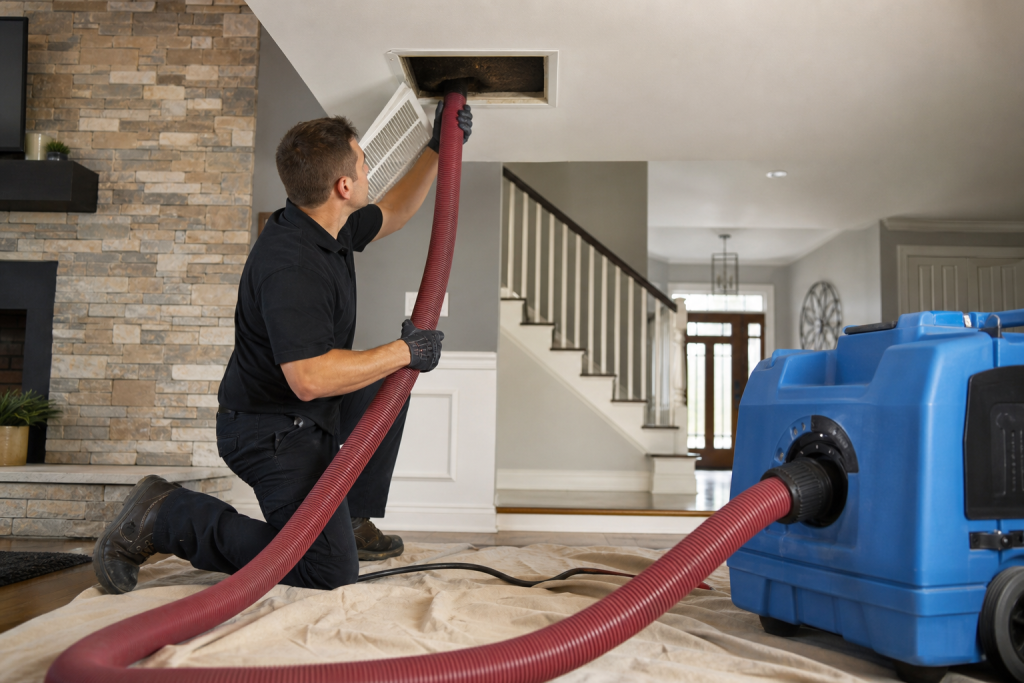
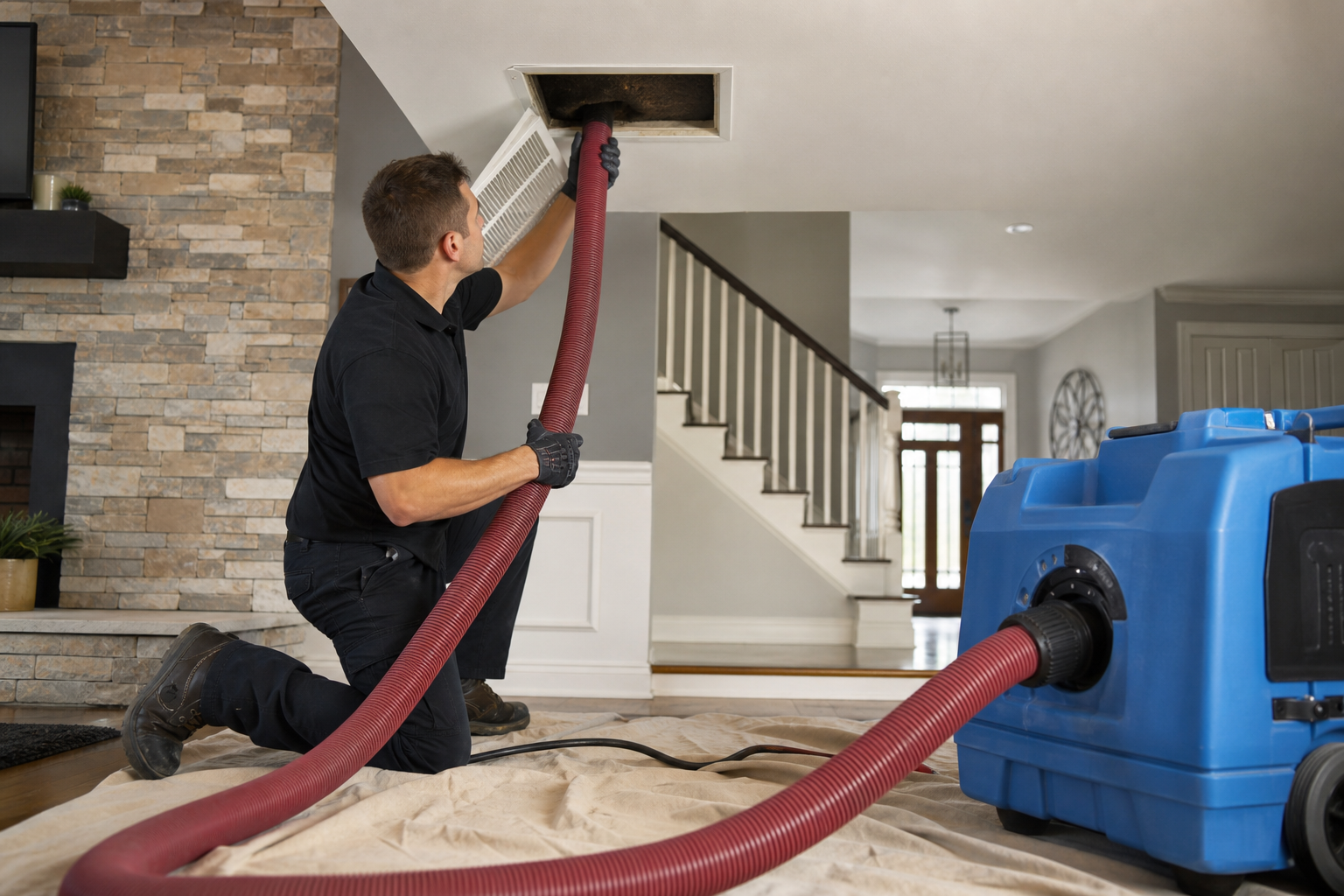
- Equipment mobilization — Rotobrush systems, Nikro HEPA vacuums, Abatement Technologies negative air machines
- Technician availability (at Bluepeak, that’s Jeffrey Morgan personally, not a rotating subcontractor crew)
Companies promising 90-minute arrival for “emergency duct cleaning” are typically generalist cleaners with portable equipment doing surface-level work. We’ve been called to redo these jobs in Roxborough and West Philly — homeowners paid $199 for a quick vacuum, then still had the original problem.
Our typical emergency assessment timeline in Philadelphia: same-day phone consultation, next-day or day-after inspection for true emergencies, scheduled cleaning within 48-72 hours of scope approval. If someone promises faster, ask what equipment they’re bringing and whether they’ll provide written scope and before/after photos.
Documentation Steps That Protect Your Insurance Claim
If flooding, fire, or puff-back triggered your duct concerns, documentation determines whether insurance covers the work.
- Photograph everything before touching it. Water lines on ductwork, soot at registers, debris in returns.
- Record exact HVAC shutdown time. Insurance adjusters use this to determine whether running the system worsened damage.
- Get written scope from every contractor. Not an estimate — a scope specifying what they found, what they’ll do, and why.
- Request before/after video or photos. We provide this standard; it’s your proof of work performed.
- Keep receipts for all emergency services. Mitigation, HVAC repair, and duct cleaning may all be claimable.
We’ve worked with Philadelphia homeowners through claims after Hurricane Ida remnants flooded basements across the city. The ones who documented thoroughly got full coverage. The ones who started cleanup first and asked questions later often ate thousands in costs.
When to Call a Pro — And What to Expect
Call a duct specialist when:
- An HVAC technician has confirmed the mechanical system is sound, but you suspect contamination spread through ducts
- Water mitigation has completed drying, and you need post-flood duct assessment
- You’re experiencing persistent symptoms and have ruled out CO, gas leaks, and other immediate hazards
- You need documentation for insurance or real estate transaction
When you call Bluepeak at (844) 951-3591, Jeffrey Morgan — owner and lead technician — will ask specific questions about your situation. If it’s an HVAC problem, we’ll tell you. If it’s water mitigation first, we’ll tell you that too. We’ve referred away more “emergency” calls than we’ve taken, and that’s why over 1,100 verified customers have trusted this work.
Related services in Philadelphia: Air Duct Cleaning in Carnegie, Dryer Vent Cleaning in Carnegie, and HVAC Cleaning in Carnegie.
The Bottom Line
Most Philadelphia homeowners searching “emergency air duct cleaning near me” don’t need a duct cleaner today — they need the right professional for the actual problem. Burning smells need HVAC technicians. Flooding needs mitigation first. Allergy spikes need diagnosis, not assumption.
The real emergency is misdiagnosis: spending money on the wrong service while the actual problem worsens. When duct cleaning genuinely is needed — post-puff-back, post-flood, or confirmed contamination — it deserves a specialist with proper equipment, containment protocols, and the expertise to scope the work honestly.
If you’re in Philadelphia and need help determining whether your situation actually requires duct cleaning, Bluepeak Air Duct & Vent Cleaning Pennsylvania home offers free estimates — call (844) 951-3591. Jeffrey Morgan handles assessments personally, and if we aren’t the right first call, we’ll tell you who is.
Frequently Asked Questions
If the problem started when your system turned on — burning smell, no airflow, strange noises — call an HVAC technician first. Duct cleaning fixes contamination in the ductwork; it doesn’t repair mechanical failures. Call a duct specialist only after the HVAC system is confirmed sound and you suspect debris, soot, or moisture has spread through the ducts. Call (844) 951-3591 for a free assessment if you’re unsure.
It depends on the water source and how long the ducts sat wet. Clean water from a supply line break, addressed quickly, often allows restoration. Category 2 or 3 water — sewage, street flooding, or standing water beyond 48 hours — usually requires section replacement, especially in flex duct or fiberboard. We camera-inspect to determine which sections can be cleaned and which must be replaced. Document everything with photos before cleanup if insurance may cover it.
Same-day phone consultation is realistic; same-day cleaning rarely is for legitimate emergencies. Proper response requires inspection, containment setup, and mobilization of HEPA equipment — not a quick vacuum run. Promises of 90-minute arrival typically mean generalist crews with inadequate equipment. Expect next-day inspection and 48-72 hour scheduling for actual cleaning after scope approval. Call (844) 951-3591 to discuss your timeline.
Sometimes — if the duct contamination resulted from a covered peril like fire, puff-back, or sudden water damage from a burst pipe. Routine maintenance cleaning and damage from long-term neglect or flooding from backup (unless you have sewer backup coverage) typically aren’t covered. Documentation is critical: photos, HVAC shutdown timestamps, and written scopes from contractors. We provide detailed documentation to support your claim.
Written by Jeffrey Morgan, Owner & Lead Technician at Bluepeak Air Duct & Vent Cleaning Pennsylvania, serving Philadelphia since 2012.
Need Air Duct Cleaning Help?
Call Bluepeak Air Duct & Vent Cleaning Pennsylvania — licensed & insured, here with fast after-hours help in Pennsylvania.
(844) 951-3591