
Air Duct Sanitizing Service in Pennsylvania, PA — When It’s Warranted, What It Costs, and Why Order of Operations Matters
Air duct sanitizing service in Pennsylvania typically costs $150–$400 as an add-on to professional duct cleaning, or $400–$750 when bundled with full system cleaning and inspection. Most jobs are completed same-day. Call (844) 951-3591 for a free estimate — Jeffrey Morgan, owner and lead technician, handles every job personally and will tell you honestly if your system actually needs it.
We’ve gone into Pennsylvania homes where the homeowner already paid for “sanitizing” at another company, and the ductwork was still visibly contaminated. That’s because spraying a treatment into ducts that haven’t been mechanically cleaned first is like spraying air freshener into a clogged drain — the source of the problem is still there, now with a chemical mask over it. At Bluepeak, we don’t sell sanitizing as a default upsell. We inspect, we clean, and we treat only when there’s a confirmed reason to treat.
Pennsylvania’s Climate and Housing Stock: Why Sanitizing Context Matters Here
Pennsylvania’s humidity patterns create specific conditions inside ductwork that don’t exist the same way in drier western states. Summers across the Commonwealth — particularly in the Susquehanna Valley and the Pittsburgh basin — regularly push relative humidity above 70% for weeks at a stretch. Basements in Pennsylvania housing stock, especially the post-war ranch homes and row houses common in Pittsburgh neighborhoods like Lawrenceville, Bloomfield, and Squirrel Hill, often house air handlers in chronically damp conditions.
That moisture doesn’t stay in the basement. It gets pulled through return air pathways, condenses on cooler duct surfaces in shoulder seasons, and creates the exact environment where microbial growth finds footing. We’ve opened duct systems in Harrisburg-area split-levels where the flex duct behind a basement return was visibly spotted — not because the homeowner neglected anything, but because the house’s grade and the local water table conspired against them.
This matters for sanitizing because:
- Moisture without mechanical cleaning means treatment won’t adhere properly to debris-coated surfaces
- Pennsylvania’s freeze-thaw cycles stress older duct seams, pulling unconditioned attic air into systems and introducing new contamination vectors
- Coal-region homes in northeastern PA often have decades of legacy particulate layered in original galvanized ductwork that no spray can penetrate
Jeffrey Morgan — owner and lead technician — grew up in Lawrenceville and spent his early twenties in the HVAC program at Community College of Allegheny County before recognizing that duct and vent work was the niche most contractors were doing halfway. Fourteen years later, the Pennsylvania homes that need sanitizing are the ones where we’ve first removed the mechanical load, sealed the moisture pathways, and confirmed that treatment will actually reach the surface it’s meant to protect.
What Air Duct Sanitizing Actually Is — And What It Isn’t
Sanitizing is the controlled application of an EPA-registered antimicrobial agent to the interior surfaces of cleaned ductwork. It’s not a cleaning method. It doesn’t remove dust, construction debris, pet dander, or the accumulated skin-cell matrix that actually feeds biological growth. It treats surfaces after that material has been mechanically extracted.
Here’s the order of operations we follow on every Pennsylvania job where sanitizing enters the conversation:
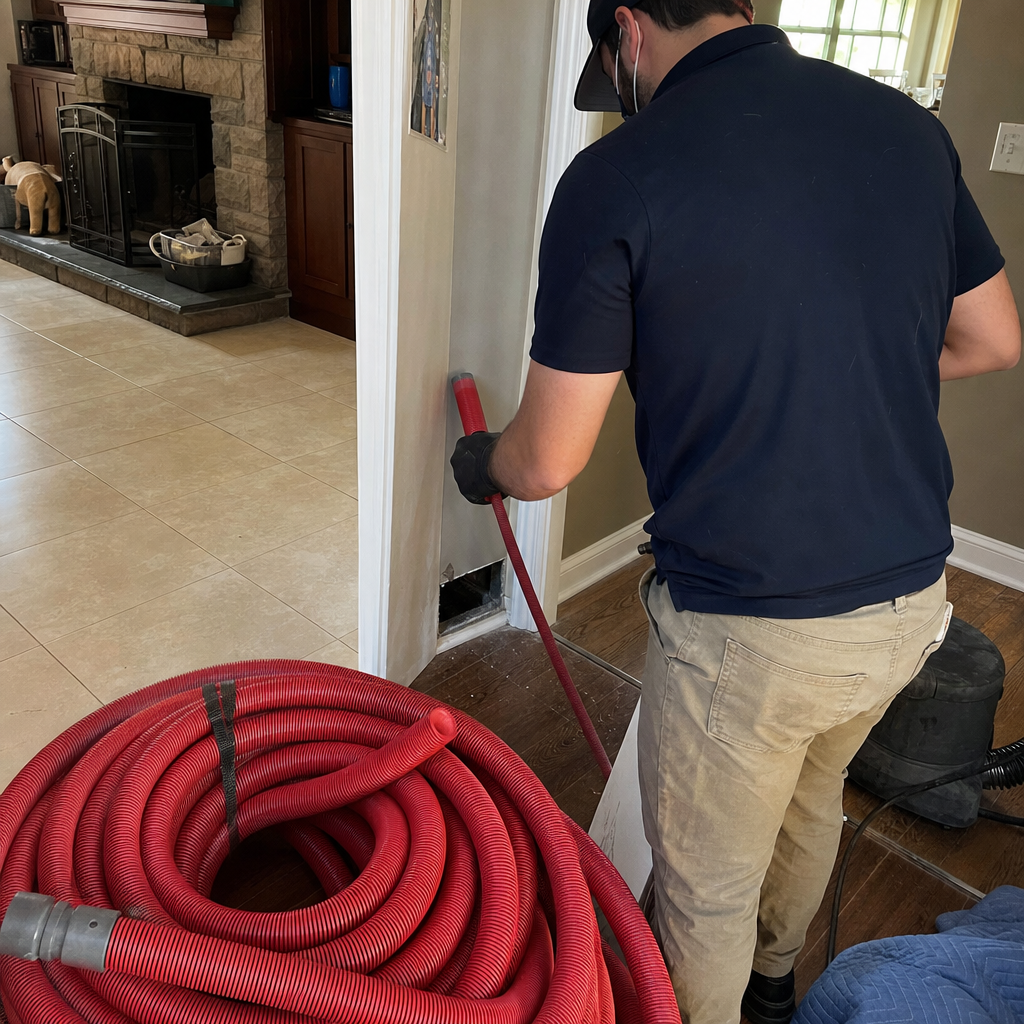
- Mechanical source removal — Rotobrush brush-agitation systems loosen adhered debris from duct walls; Nikro HEPA-rated vacuums capture it under negative pressure so nothing migrates into living spaces
- Visual inspection with borescope — we verify that surfaces are clean enough for treatment to make contact; if we hit a section of deteriorated flex duct or a disconnected boot, we flag it for repair first
- Moisture-source assessment — is the basement dehumidifier adequate? Is the condensate drain flowing? Is there a return pulling air from a damp crawlspace? Sanitizing a wet system is temporary at best
- Targeted application — only if steps 1–3 confirm it’s warranted
The application itself varies by duct type and contamination pattern. Rigid metal trunk lines in older Pittsburgh-area homes may get a targeted ULV (ultra-low volume) fog that reaches the full perimeter without oversaturating. Flex duct, more common in 1980s–2000s Pennsylvania construction, sometimes needs direct-contact wipe-down at access points where the fog can’t penetrate the corrugated interior. We use Abatement Technologies containment tools to isolate the work zone — the same equipment restoration contractors deploy after water losses — because the goal is treating the duct, not the living room.
What we won’t do: sell sanitizing as a standalone service to a homeowner who hasn’t had proper mechanical cleaning in five years. If I wouldn’t run it in my own house, I won’t recommend it in yours.
When Sanitizing Is Legitimately Warranted in Pennsylvania Homes
After fourteen years and over 1,100 verified reviews, we’ve identified three Pennsylvania-specific scenarios where post-cleaning sanitizing is the right call — not the profitable call, the right one:
Documented water intrusion events. Basements flood in Pennsylvania. Sump pumps fail, foundation cracks widen after hard freezes, and water finds return air pathways. When we’ve cleaned a system after a documented intrusion and the homeowner reports recurring musty odor through humid July and August, sanitizing addresses the biological footprint that mechanical extraction alone won’t fully neutralize.
Post-renovation systems with organic debris loading. Pennsylvania’s older housing stock means constant renovation — knob-and-tube removal, plaster demolition, hardwood refinishing. Drywall dust is inorganic and abrasive, but the demolition process also introduces insect fragments, rodent droppings from disturbed wall cavities, and the organic debris that supports growth. We’ve cleaned systems in restored Harrisburg Victorians where the ductwork was technically “clean” but still carried the signature odor of old lath-and-plaster disturbance. Sanitizing, after thorough mechanical extraction, resolves that residual.
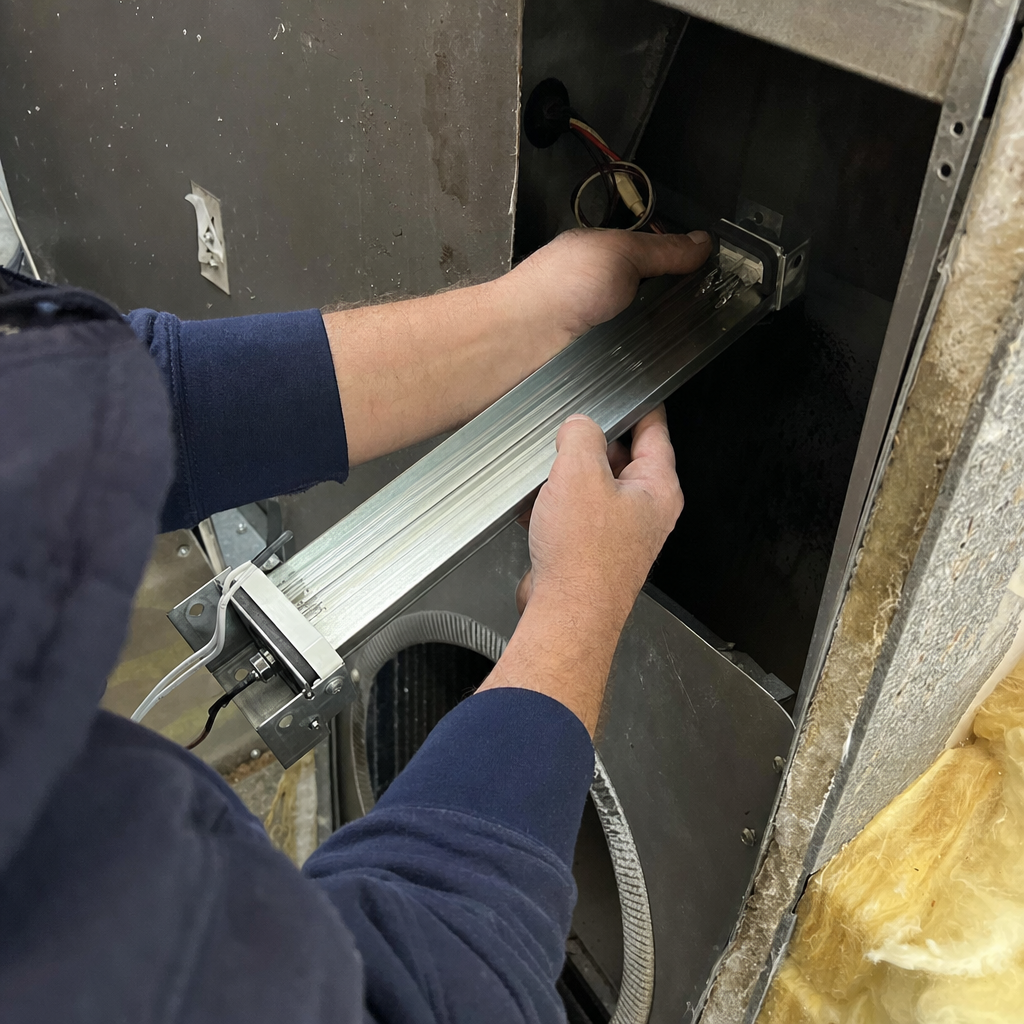
Prior musty-HVAC complaints through humid seasons. Some Pennsylvania homeowners run their systems for weeks before realizing the “basement smell” is circulating through every vent. When we’ve traced that to microbial loading in the air handler and supply plenum — common in systems with inadequate filtration and no UV control — sanitizing after cleaning breaks the cycle. But only if we also address the filtration gap, which is where our Air Quality & Sanitizing in Pennsylvania work extends to Honeywell and Aprilaire product recommendations.
What Does Air Duct Sanitizing Service Cost in Pennsylvania?
Pricing depends on system size, accessibility, and whether sanitizing follows our cleaning or someone else’s. Here’s what Bluepeak charges:
| Service Item | Price Range |
|---|---|
| Sanitizing add-on to Bluepeak duct cleaning (standard residential) | $150 – $250 |
| Sanitizing add-on with complex system (multiple zones, hard duct access) | $250 – $400 |
| Full duct cleaning + inspection + sanitizing bundle | $400 – $750 |
| Standalone sanitizing (only if system was professionally cleaned within 6 months) | $200 – $350 |
| Commercial/light industrial sanitizing application | $500 – $1,200 |
We don’t quote over the phone for standalone sanitizing without verifying your system was actually cleaned — not “vacuumed,” not “blown out,” but properly brush-agitated and HEPA-extracted. We’ve had Pennsylvania homeowners tell us their ducts were “just cleaned” and we find an inch of debris on the return drop. Sanitizing that would be malpractice.
Every estimate is free, and Jeffrey Morgan personally evaluates whether your situation warrants the treatment. Call (844) 951-3591.
How to Tell If a Pennsylvania Duct Sanitizing Offer Is Legitimate
The market’s full of companies that will fog your ducts for $99 and call it a day. Here’s how to evaluate what you’re actually getting:
| What to Ask | Red-Flag Answer | What Bluepeak Does |
|---|---|---|
| “Do you clean before sanitizing?” | “The sanitizer breaks down the debris” | Mechanical extraction first — Rotobrush + Nikro HEPA — every time |
| “What equipment do you use?” | “Proprietary system” or “industrial fogger” | Named brands: Rotobrush, Nikro, Abatement Technologies — equipment you can verify |
| “Who’s doing the work?” | “One of our trained techs will be assigned” | Jeffrey Morgan, owner, on every job — accountability by name |
| “What if the smell comes back?” | “We’ll retreat at a discount” | We find the moisture or filtration source so retreatment isn’t needed |
The companies that scare you into sanitizing with mold-test photos from someone else’s house — we’ve seen their postcards in Pennsylvania mailboxes. The companies that can’t name their equipment or their technician aren’t specialists. They’re volume operators, and your ductwork is their assembly line.
What Sanitizing Doesn’t Fix — And What We Do Instead
Sanitizing has hard limits that honest technicians acknowledge:
- It doesn’t remove debris — only mechanical agitation and negative-pressure extraction do that
- It doesn’t fix moisture sources — a leaking condensate pan or humid crawlspace will recontaminate treated surfaces
- It doesn’t seal duct leaks — unsealed return pathways pull contamination back in from attics, basements, and wall cavities
- It doesn’t upgrade filtration — the same cheap fiberglass filter that let spores colonize the first time will let them colonize again
This is why Bluepeak’s scope extends beyond Air Quality & Sanitizing to duct repair and sealing, and why we carry Honeywell and Aprilaire air-quality products. After fourteen years focused exclusively on this trade, we’ve learned that the homeowner who calls for sanitizing often needs a humidity-control strategy and better filtration more than they need another chemical treatment. We address the source, the system, and the air itself — no need to call a second company.
FAQs
Air duct sanitizing service in Pennsylvania typically ranges from $150 to $400 as an add-on to professional cleaning, or $400 to $750 bundled with full system cleaning and inspection. The exact price depends on your home’s duct configuration, the number of zones, and whether we can access all trunk lines without cutting new openings. Call (844) 951-3591 for a free, no-obligation estimate — we’ll tell you honestly if your system even needs it.
No — sanitizing treats surfaces after mechanical cleaning but does not remove established mold growth or fix the moisture that caused it. If we find visible mold during inspection, we identify the moisture source and recommend remediation before any treatment; in Pennsylvania’s humid basements, that’s often a dehumidification or drainage issue that needs addressing first. Call (844) 951-3591 and Jeffrey Morgan will assess whether you’re dealing with surface spotting or a deeper moisture problem.
No — sanitizing without prior mechanical cleaning is ineffective and, in our view, a waste of money; the treatment can’t reach duct surfaces buried under debris, and you’re paying for a chemical application that won’t last. We’ve cleaned Pennsylvania systems where a previous company charged for “sanitizing” that left the original contamination completely intact. Call (844) 951-3591 for a proper evaluation and upfront pricing on the full process done right.
We typically schedule within 2–3 business days for standard requests, and same-day or next-day for urgent situations like post-water-intrusion or pre-closing home purchases. Jeffrey Morgan handles every job personally, so availability reflects his calendar — fourteen years of 4.8-star reviews means we stay busy, but we don’t overbook to the point of rushing. Call (844) 951-3591 to check this week’s openings.
Ready to Find Out If Your Pennsylvania Home Actually Needs Duct Sanitizing?
Don’t guess, and don’t let a telemarketer guess for you. Jeffrey Morgan — owner and lead technician at Bluepeak Air Duct & Vent Cleaning Pennsylvania — will inspect your system personally, show you what the borescope reveals, and recommend exactly what your situation warrants: cleaning, sealing, sanitizing, or sometimes just better filtration. No treatment without cause. No upsell without explanation. Over 1,100 verified customers have reviewed this work, and our phone number hasn’t changed in fourteen years. Call (844) 951-3591 for your free estimate today.
Written by Jeffrey Morgan, Owner & Lead Technician at Bluepeak Air Duct & Vent Cleaning Pennsylvania, serving Pennsylvania, PA.