
How to Choose the Right Air Duct Cleaning Company in Philadelphia
The right air duct cleaning company in Philadelphia has verifiable equipment specs, owner-level accountability, and a review profile that proves technical depth—not just politeness. Ask about vacuum CFM ratings, whether they carry both rotary brush and air-whip systems, and how they’ll document your register count and system layout before starting. If you’d rather not do the homework yourself, call Bluepeak at (844) 951-3591 for a free estimate.
Here’s the uncomfortable truth we’ve learned over 14 years in Philadelphia homes: a company can show you NADCA certification, a 4.8-star average, and a slick before-and-after photo—and still do a job that’s technically compliant but practically useless. We’ve followed behind competitors in neighborhoods from Fishtown to Chestnut Hill where the homeowner paid $400, got a certificate, and still had debris caked in the return trunk because the crew used a portable vacuum with 1,500 CFM when the job needed 5,000+. The photo looked great. The system wasn’t clean.
The mediocre majority is harder to spot than the outright scams. This guide covers what we actually look for when we hire specialists in our own trade—the equipment, documentation, and accountability signals that separate a thorough job from an expensive performance.
Verify the Equipment: What to Ask and Why It Matters
Equipment separates specialists from generalists faster than any credential. In Philadelphia’s older housing stock—tight rowhome ducts in Passyunk, plaster-and-lath systems in Germantown, postwar ranch lines in the Northeast—you need tools matched to the actual ductwork, not whatever’s in the van that day.
Ask these specific questions on the phone:
- Is your vacuum truck-mounted or portable? Truck-mounted systems pull stronger negative pressure. Portables have their place for high-rise condos or inaccessible crawlspaces, but they should be HEPA-rated units like Nikro’s line—not repurposed shop vacs.
- What’s the CFM rating? For residential duct cleaning, we want to see at least 4,000–5,000 CFM. Anything under 3,000 struggles to maintain containment during agitation. If they don’t know the number, they don’t know their equipment.
- Do you carry both rotary brush and air-whip tooling? Flexible ductwork (common in 1980s–90s Philadelphia builds) gets damaged by stiff rotary brushes. Rigid metal ducts need brush agitation to dislodge buildup. A technician carrying both—and knowing when to switch—is a technician who’s actually encountered real ductwork.
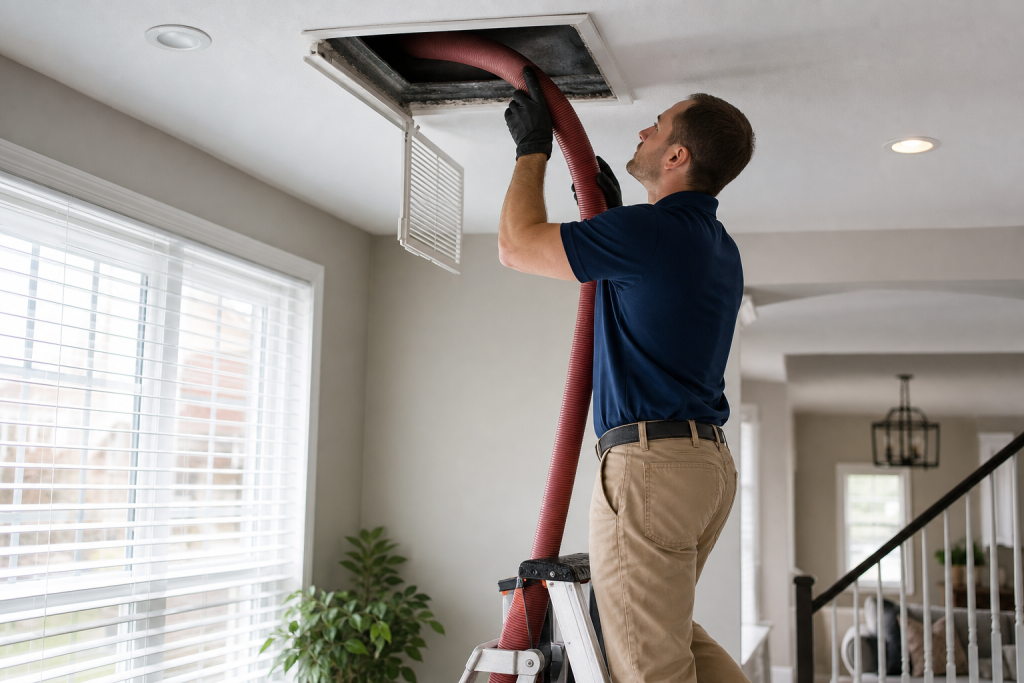
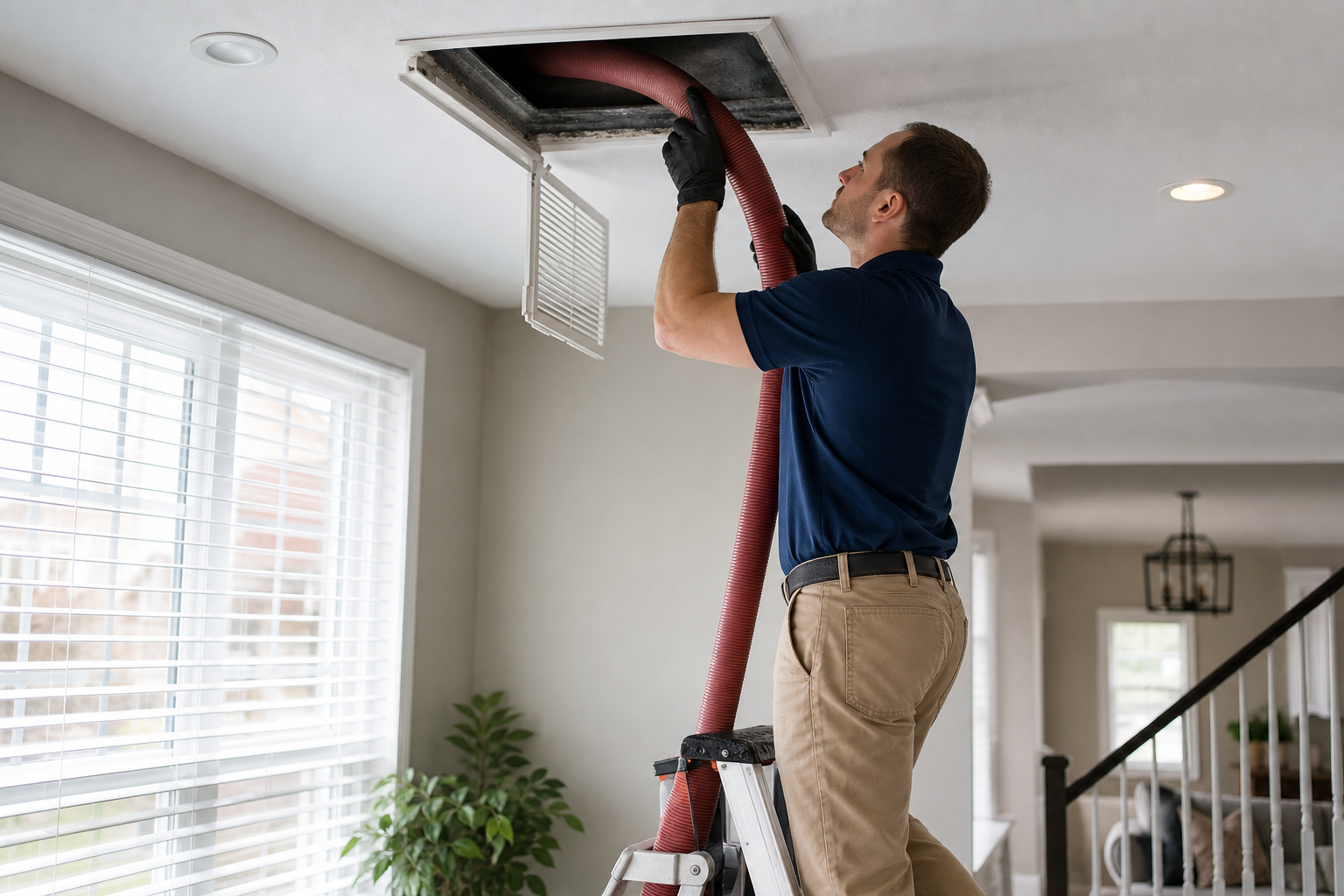
- What containment do you use for the return side? The return-air trunk is where the heaviest debris accumulates, and it’s where cut-rate jobs skip. Abatement Technologies makes the portable containment systems serious crews use to isolate this work.
At Bluepeak Air Duct & Vent Cleaning Pennsylvania home, we run Rotobrush brush-agitation systems paired with Nikro HEPA vacuums because we’ve tested what actually extracts debris from Philadelphia’s varied duct configurations—not what looks impressive in a brochure.
Read Reviews for Technical Depth, Not Just Politeness
Five stars for “on time and friendly” tells you nothing about whether your ducts are clean. After 1,144 reviews, we’ve learned what phrases signal a real technical job versus a pleasant sales interaction.
Look for these specific quality indicators in Philadelphia duct cleaning reviews:
- Specific mentions of register count or access points: “They cleaned all 14 supply registers and the 3 return grilles” means someone actually counted and communicated scope.
- References to debris volume or type: “Pulled two full bags of plaster dust and construction debris” beats “great results” every time.
- Post-job documentation discussed: “Showed me photos from inside the main trunk” indicates transparency, not just a polished marketing shot of one vent.
- Problem-solving mentions: “Found a disconnected duct in the basement and resealed it” reveals diagnostic attention, not just surface cleaning.
Red-flag phrases: “quick and easy,” “in and out in an hour,” or any review that focuses entirely on price. A thorough residential job in a typical Philadelphia rowhome takes 3–4 hours minimum. We’ve spent full days in larger Center City conversions with complex duct networks.
Our review profile at Bluepeak reflects this—we’re proud of the 4.8-star average, but more proud that customers specifically mention Jeffrey’s hands-on problem-solving and the debris we actually removed.
Why Owner-as-Technician Changes Everything for Duct Cleaning
Duct cleaning is uniquely vulnerable to the subcontractor model. The person who sold you on the phone isn’t the person in your attic. The crew that shows up may have been hired last week, trained on three jobs, and paid per completion—not per hour.
When Jeffrey Morgan—owner and lead technician—handles your job personally, three things change:
- Accountability is immediate. There’s no escalation chain, no “I’ll talk to my manager.” The decision-maker is on-site, looking at your specific duct configuration.
- Consistency compounds. After 14 years focused exclusively on air ducts and vents in Philadelphia, Jeffrey recognizes patterns: the sagging flex duct common in 1970s Northeast Philly splits, the access challenges in historic Society Hill homes, the post-renovation debris profiles from Fishtown flips. A rotating crew relearns this on your dime.
- Problem-solving doesn’t get upsold. Disconnected return, damaged boot, inadequate sealing—these get flagged and fixed or quoted transparently, not ignored because “that’s not what we were sent for” or pushed into a separate sales call.
We’ve been called to jobs in Roxborough where the previous company “cleaned” the ducts but never opened the return plenum because it required moving a water heater. An owner-technician figures out how to do it right. A subcontractor figures out how to move to the next appointment.
Demand Pre-Job Documentation Without Asking
A legitimate company in Philadelphia should provide four things before any equipment runs:
- System diagram or register count: “You have 11 supply registers, 2 return grilles, and one main trunk accessible from the basement.” This proves they looked, not just glanced.
- Equipment setup confirmation: Which vacuum, which agitation tools, and why for your specific duct types.
- Written scope: Exactly what’s included, what’s additional, and what happens if they find damage or disconnection.
- Containment plan: How they’ll protect your home during the process—floor coverings, vent sealing, HEPA filtration on exhaust.
If you have to ask for these, you’re already working harder than the company. We document every Philadelphia job this way because it’s how we’d want our own homes treated—and because 14 years of focused work has taught us where the misunderstandings happen.
The One-Phone-Call Technical Test
You can assess technical depth in a single conversation. Here’s what to ask and what a knowledgeable answer sounds like:
| Your Question | Knowledgeable Answer Sounds Like | Scripted Sales Answer Sounds Like |
|---|---|---|
| “My house is a 1920s rowhome with original plaster. Any concerns?” | “Plaster dust and older duct sealing are common—we’ll check for asbestos tape on original wraps and adjust agitation pressure for fragile connections.” | “No problem, we do all kinds of homes.” |
| “Do you clean the return side too?” | “Yes, and it’s usually dirtier. We’ll need access to the return plenum—sometimes that’s basement, sometimes closet. Where’s yours?” | “Of course, we clean everything.” |
| “How long should this take?” | “For your square footage and register count, probably 3–4 hours. Rushing means missing branches or skipping the return trunk.” | “About an hour or two, we’re very efficient.” |
| “What if you find a disconnected duct?” | “We’ll show you, explain the impact on airflow and efficiency, and either repair it if it’s straightforward or quote it separately if it needs materials.” | “We can refer you to someone for repairs.” |
The knowledgeable answer is specific, conditional, and asks you follow-up questions. The scripted answer is reassurance without substance.
When to Call a Pro
If you’ve read this far, you’re already doing more diligence than most Philadelphia homeowners. Here’s when the DIY research phase should end with a phone call: visible dust emission from registers, uneven heating or cooling between rooms, a musty or stale odor when the system runs, or it’s been more than 5–7 years since any cleaning. Post-renovation jobs are especially urgent—construction debris in ductwork doesn’t degrade; it circulates.
Related services in Philadelphia: Air Duct Cleaning in Carnegie, Dryer Vent Cleaning in Carnegie, and HVAC Cleaning in Carnegie.
The Bottom Line
Choosing right comes down to verifiable specifics: equipment you can name and measure, reviews that prove technical work, and accountability that doesn’t disappear when the truck leaves. The Philadelphia market has plenty of companies that will take your money and hand you a certificate. Fewer will show you what came out of your ducts, explain why it mattered, and stand behind the work with their name on the business.
At Bluepeak, Jeffrey Morgan handles every job personally with Rotobrush and Nikro equipment built for this specific work—not generalist tools pressed into service. We’ve got 14 years and 1,144 reviews that say we do what we document. If you’re in Philadelphia and want an estimate with no pressure, call (844) 951-3591. We’ll count your registers, explain your system, and let you decide.
Frequently Asked Questions
Most thorough residential duct cleaning in Philadelphia runs $400–$700 for a typical single-family home, with rowhomes and smaller condos sometimes less and larger historic properties more. The price should scale with register count, system accessibility, and whether dryer vent or HVAC cleaning is bundled—not with aggressive upselling mid-job. Call (844) 951-3591 for a free estimate based on your specific home.
No. NADCA certification establishes baseline training and ethical standards, but it doesn’t specify equipment requirements, job duration, or documentation practices. We’ve seen NADCA-member companies in Philadelphia complete “cleanings” in 90 minutes with inadequate vacuum power and no return-side work. Use certification as a starting filter, then verify the equipment and accountability factors we covered above.
Every 5–7 years for typical residential systems, sooner if you have pets, allergies, or recent renovation. Philadelphia’s humidity swings—sticky summers, dry winter heating seasons—can accelerate dust compaction and microbial growth in ductwork. Older homes with original plaster or previous water damage often need more frequent attention. If you’re unsure when yours were last cleaned, that’s usually a sign it’s time.
You can clean visible register covers and the first few inches of duct with a vacuum and brush, but you cannot safely or effectively clean the full system without professional negative-pressure equipment. The main trunk lines, return plenum, and deep branch ducts require contained agitation and extraction—attempting DIY with household tools risks damaging flexible ductwork, dislodging debris deeper into the system, or disturbing asbestos-containing materials in pre-1980s Philadelphia homes. For anything beyond surface cleaning, call a specialist.
Written by Jeffrey Morgan, Owner & Lead Technician at Bluepeak Air Duct & Vent Cleaning Pennsylvania, serving Philadelphia since 2012.
Need Air Duct Cleaning Help?
Call Bluepeak Air Duct & Vent Cleaning Pennsylvania — licensed & insured, here with fast after-hours help in Pennsylvania.
(844) 951-3591